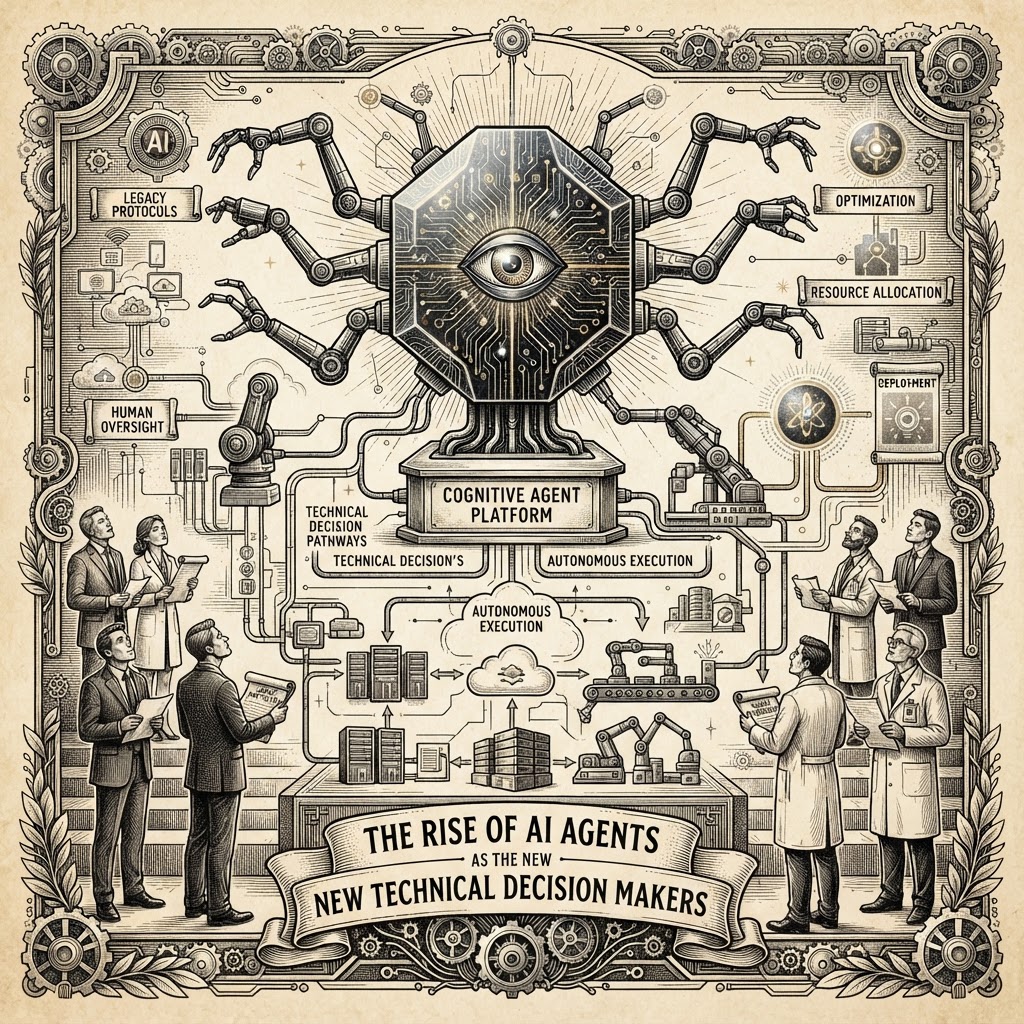
The Rise of AI Agents as the New Technical Decision Makers
AI coding agents are fundamentally altering the developer tool landscape by acting as technical buyers that discover, select, and implement software. This transition requires companies to rethink their marketing and documentation strategies to ensure their products are compatible with automated workflows.

The Shift in Developer Procurement
For years, developer-tool companies fought for the attention of individual engineers. They optimized documentation for search engines, published extensive tutorials, and sponsored major conferences. The goal was simple: ensure that when a developer searched for solutions to a specific problem, their product appeared early in the decision process. That standard discovery funnel is currently undergoing a massive transformation.
Increasingly, the human developer is not the one performing the search. Instead, coding agents like Claude Code, Cursor, and various open-source models are taking the lead. A developer can now simply ask an agent to add search functionality or observability to an existing application. The agent then inspects the repository, evaluates the technology stack, compares competing solutions, and writes the actual integration code. In many cases, the human developer never visits the vendor's homepage, effectively removing the traditional marketing touchpoints from the transaction.
Rethinking Technical Benchmarks
Because agents operate differently than humans, we need new ways to measure success. Armature has introduced Dev Tools Leaderboards to address this shift. Unlike traditional surveys or popularity contests, these leaderboards run controlled experiments by asking agents to solve problems within specific, sandboxed repositories.
This methodology is superior to simple LLM queries because it mandates an actual implementation. The agent is forced to install the tool, resolve dependencies, and ensure the configuration works within the existing project architecture. A judge records whether the product was merely discussed or if it was successfully wired into the system. This provides a clearer view of how agents prioritize tools based on installation ease and compatibility, rather than just brand awareness.
The Compressed Discovery Funnel
Historically, the discovery funnel consisted of distinct steps: identifying the problem, searching for options, comparing vendors, evaluating documentation, and finally implementing the chosen solution. AI agents have the potential to compress this entire pipeline into a single interaction. While the underlying steps still exist, they now happen within the internal reasoning engine of the agent.
This shift means that software companies are no longer communicating exclusively with developers. They are now communicating with the AI agents acting on those developers' behalf. Because agents prioritize functionality, clear installation paths, and machine-readable documentation, developer-tool companies must adapt their interfaces to accommodate automated systems.
Why Contextual Selection Matters
One of the most important takeaways from these benchmarks is that technology selection is highly contextual. There is no universally superior tool. A search solution that excels in a high-throughput, distributed environment might be an over-engineered burden for a small application using a standard relational database.
Advanced agents are becoming surprisingly capable of incorporating these constraints. They evaluate the repository language, the existing dependencies, and the specific architecture of the project before making a recommendation. Consequently, the challenge for technology vendors is not to achieve universal brand dominance, but to communicate clearly when their product is the most logical choice. Vendors must focus on defining the precise architectural boundaries where their tool provides genuine value.
Documentation as a Product Interface
Documentation is transitioning from a passive resource into a critical product interface. When an agent attempts to implement a new technology, it requires fast, accurate answers to specific questions: How is this installed? What is the minimal configuration? Is there a version compatible with this specific language?
If the documentation is hidden behind complex navigation, inconsistent examples, or fragmented pages, the agent may struggle to complete the integration. In this environment, a product with a clear, concise, and predictable installation flow has a distinct competitive advantage over a more feature-rich but poorly documented alternative. We are entering an era where Agent Acquisition Optimization is just as important as traditional SEO.
Conclusion: The New Competitive Surface
We are witnessing the emergence of a new buying participant in the developer-tool market. While the human developer still sets the high-level objective, the coding agent increasingly handles the tactical implementation. For vendors, this makes agent-driven selection a vital competitive surface.
To thrive in this new landscape, companies must ensure their products are not just human-readable, but also agent-accessible. By providing robust examples, predictable CLI commands, and clear architectural guidance, companies can make their tools the default choice for agents navigating modern software stacks. The goal is to move beyond mere visibility and ensure that when a problem arises, the agent knows exactly why, when, and how to select your technology.