The Coding Test Is the Exploit: Why North Korean Hackers Are Targeting Developer Trust
Recent cyber campaigns reveal that threat actors are hiding malicious payloads within functional coding projects to exploit the standard developer workflow. By embedding malware in unsuspecting files, attackers leverage the inherent trust developers place in recruitment processes to compromise high-value workstations.
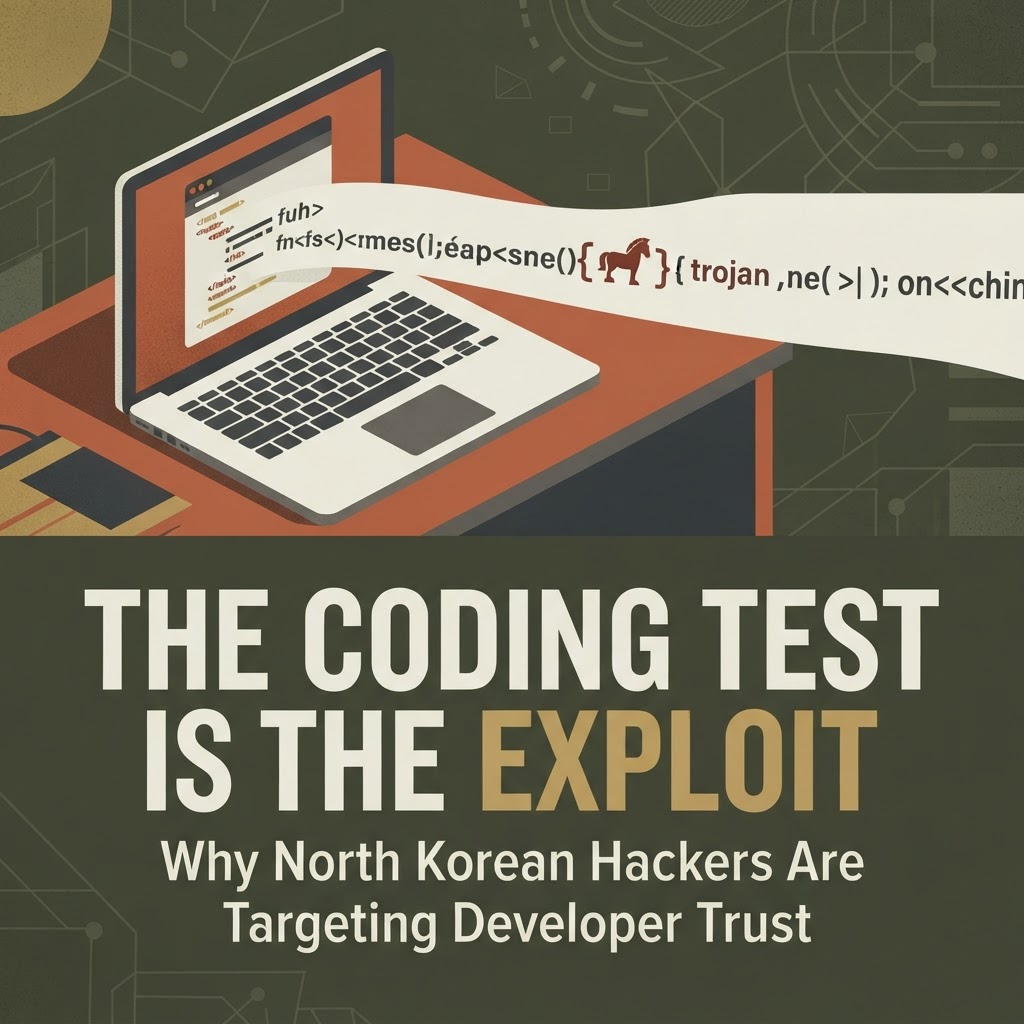
The Hidden Danger of the Modern Interview Process
For software developers, downloading third-party code and executing it locally is a fundamental part of the job. You clone a repository, install dependencies, spin up a development server, and debug whatever breaks during the process. This routine, while standard, has become the primary vector for a concerning new campaign associated with North Korean threat actors. These attackers pose as recruiters, distributing functional coding projects that secretly harbor malware. The malicious payload is often concealed inside SVG country flag images, reconstructed at runtime, and subsequently used to steal sensitive data, including credentials and cryptocurrency. While the technical sophistication of these exploits is notable, the broader security crisis lies in the fact that attackers have successfully identified a workflow where executing untrusted code is a mandatory step in a job application.
Rethinking the Developer Attack Surface
Traditional security training often emphasizes the risks of suspicious attachments or unknown executables. However, these rules are remarkably difficult to apply to a developer during an interview. Candidates expect to receive source code from strangers, they expect to install packages, and they fully anticipate that scripts will run to initialize an environment. An application consisting of standard files like package.json, server-side JavaScript, and various assets looks entirely normal. It resembles actual work. This reality provides attackers with something more valuable than a software vulnerability: a legitimate context for the victim to execute their malicious payload voluntarily.

The SVG Deception
Recent reporting indicates that attackers are hiding Base64 encoded payload fragments within HTML comments inside SVG images. These files, often representing country flags, appear as harmless visual assets. A seemingly innocuous JavaScript file then reads these fragments and reconstructs the malware when the server starts. This is a brilliant move because developers categorize files mentally. A JavaScript file might get a cursory glance, but an image file sitting in an assets directory is almost never audited for code execution logic. This exploits a hierarchy of attention where the most dangerous code is often hidden in the least scrutinized locations. File extensions no longer serve as reliable indicators of security, and the visual rendering of the flag confirms the victim's bias that the project is safe.
Why Functional Malware Repositories Are Winning
One critical detail is that these projects actually function as expected. An application that crashes instantly creates suspicion, but a polished project that demonstrates expected behavior creates confidence. The attacker does not need to disrupt the application to succeed. They simply allow the malware to coexist with the legitimate codebase. A developer might spend an hour examining complex business logic without realizing that their environment was compromised the moment they executed the start script. The repository is not just a test for the developer, but a test of the developer's machine security.
The Rising Risk of AI Configuration Theft
Perhaps most alarming is the targeted collection of AI configuration files. Malware discovered in these campaigns explicitly searches for folders related to tools like Claude, Cursor, and Gemini. These directories contain project context, conversation history, and API references that provide a machine readable map of a developer's workflow. This allows attackers to understand exactly what a developer is building and which systems hold the most value. As AI integration deepens, these endpoints become gateways to an organization's most sensitive strategic intellectual property.
Securing the Hiring Pipeline
Organizations must acknowledge that the hiring process itself has become a high risk activity. Coding assessments provided by unknown entities should be treated with the same scrutiny as any untrusted software. The safest approach is to ensure that no interview repository is ever executed on a primary workstation. Developers should utilize disposable virtual machines, isolated containers, or dedicated cloud environments that lack access to production credentials, SSH keys, or personal data. By moving the assessment to a hardened, empty environment, the potential for downstream supply chain compromise is significantly mitigated. We must stop assuming that professional appearance equates to security, as the most effective exploit today is the professional trust we place in one another.