GPU-Accelerated Indexing Shifts the Burden of Search Infrastructure
Moving vector index construction from the CPU to the GPU does more than increase raw speed; it fundamentally separates background maintenance from production search traffic. This architectural decoupling represents a shift in how we approach capacity planning for modern, data-intensive AI applications.
The Architecture of Vector Search Contention
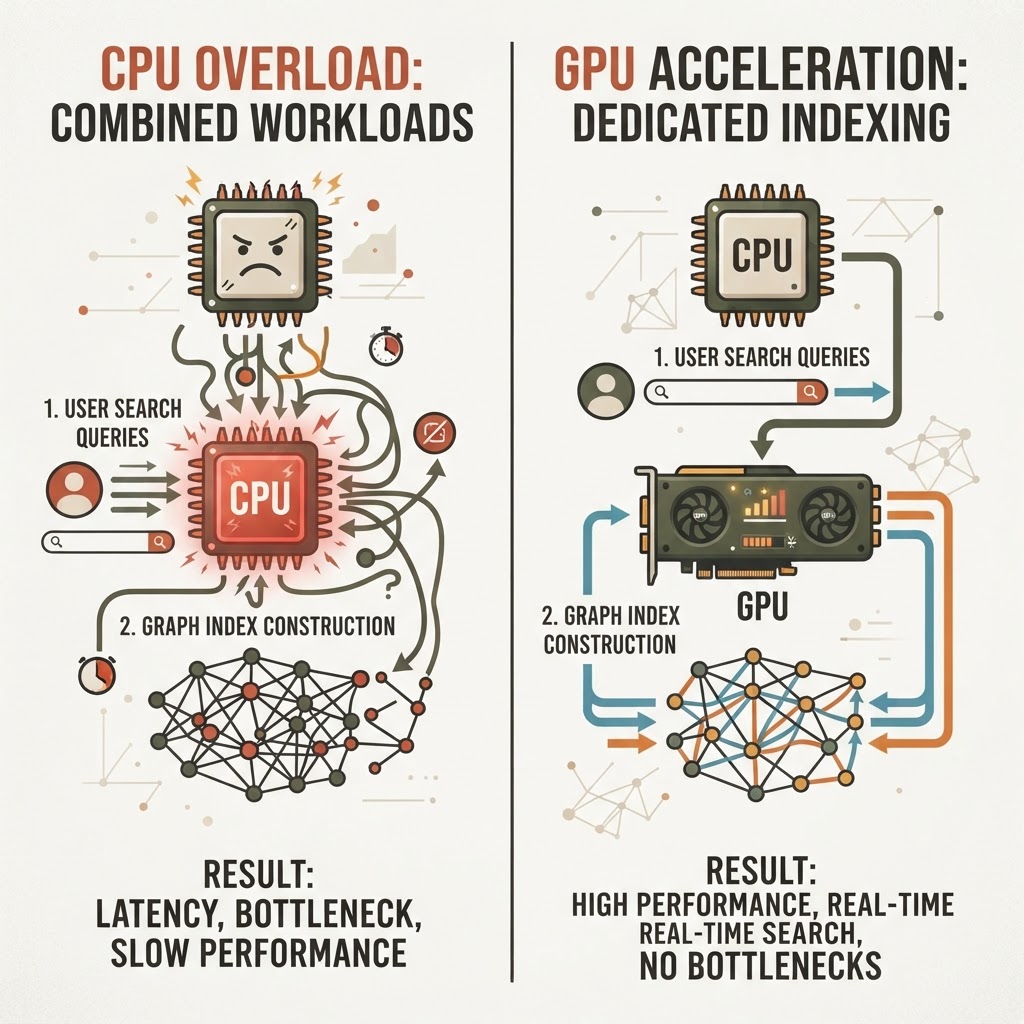
Vector databases serve as the bedrock of modern retrieval augmented generation and recommendation engines. For years, the conventional wisdom held that vector search is a compute-intensive task that primarily taxes the CPU. Traditional HNSW (Hierarchical Navigable Small World) index building is a voracious consumer of CPU cycles. It requires massive amounts of neighbor selection, distance calculations, and graph pointer manipulation. When a production system attempts to ingest new data while simultaneously serving end-user queries, a resource bottleneck occurs. The CPU is forced to arbitrate between maintaining the search structure and fulfilling search requests. This conflict creates unpredictable latency spikes and degrades the quality of experience for end users.
Offloading to the GPU: A Change in Strategy
Recent benchmarks from Elastic, utilizing NVIDIA cuVS technology, demonstrate that indexing 138 million vectors in under 10 minutes is possible. While this headline speed is impressive, the real victory is found in the improved stability of concurrent search operations. By moving the vector index construction phase to the GPU, we effectively isolate the resource-heavy background tasks from the query-critical CPU tasks. In a standard CPU-heavy setup, ingestion and search compete for the same execution units. With a GPU-augmented architecture, the GPU handles the heavy lifting of building the graph, while the CPU remains dedicated to request coordination, lexical filtering, and final result ranking. This architectural separation acts as a form of workload isolation that is impossible to achieve in a shared-CPU environment.
The Real Cost of Ingestion
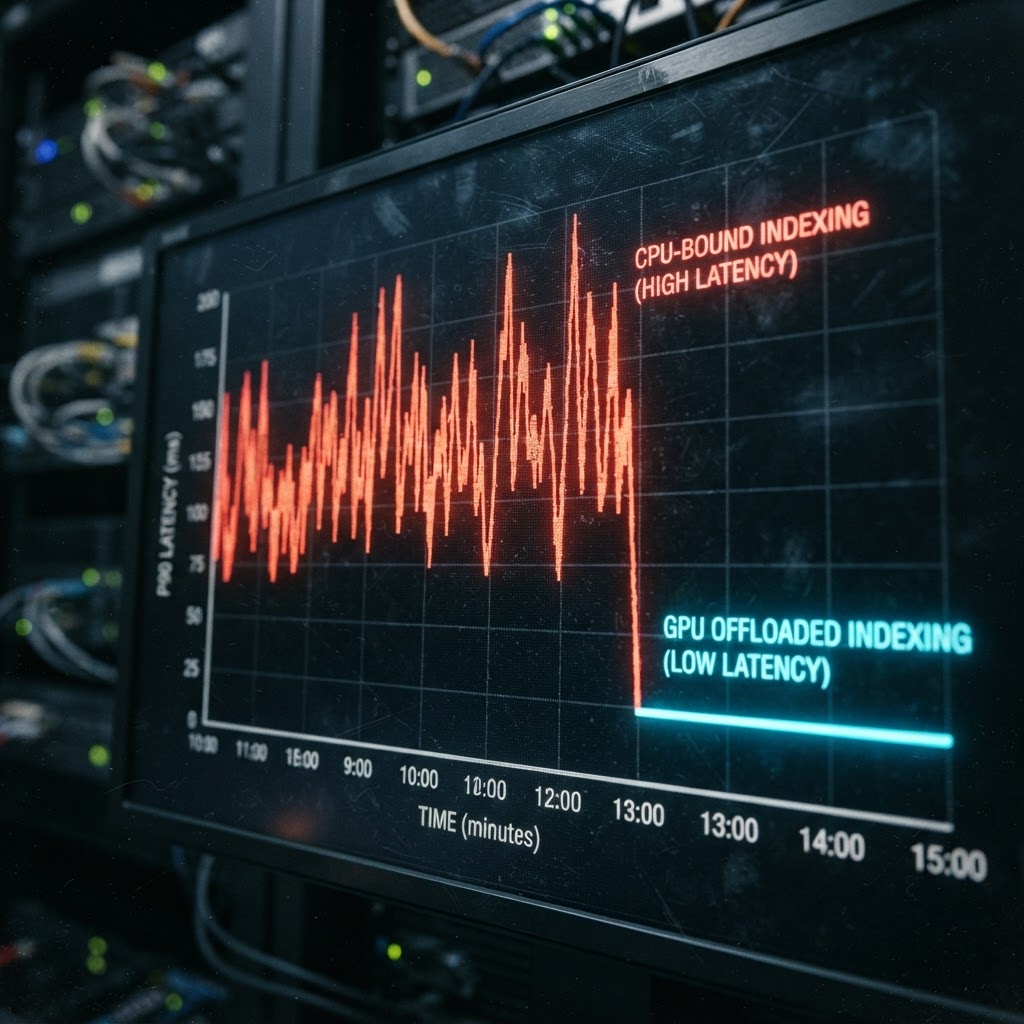
To understand the value of this change, one must rethink how we measure indexing. Many engineers assess performance purely by total throughput, such as vectors indexed per second. However, this metric ignores the opportunity cost of that indexing. If a system indexes at high speed but causes p90 query latency to jitter during the process, the performance gain is illusory. In production environments, data is rarely static. Whether through real-time telemetry, user interaction updates, or periodic re-embedding as models evolve, the vector index is a living, breathing component of the application. If the process of updating the index makes the system less capable of serving users, the cost of that indexing is actually a reduction in total system reliability.
Scaling for Modern Data Lifecycles
Modern AI applications require continuous maintenance. As embedding models improve, organizations often face the need to re-index hundreds of millions of vectors. Historically, this meant either accepting a massive dip in query performance or spinning up expensive, redundant hardware to handle the transition. By utilizing GPUs for indexing, companies can maintain a lower total footprint for production systems. Instead of over-provisioning CPU cores to handle the dual burden of search and background index updates, architects can design for steady-state CPU utilization, knowing the GPU will absorb the spikes of intense indexing tasks. This creates a predictable performance floor for the user, regardless of how much background processing occurs.
Rethinking Hybrid Retrieval Constraints
Hybrid search is increasingly common, as developers blend vector similarity with traditional BM25 lexical retrieval and metadata filtering. These legacy search components are highly optimized for CPUs. When HNSW indexing steals CPU cycles, these hybrid components suffer significantly. Moving the vector construction task to the GPU ensures that the CPU remains available for these critical ranking and filtering tasks. This synergy allows for more complex, multi-stage retrieval pipelines that can be executed without sacrificing the latency requirements of modern, high-traffic applications. The GPU becomes an infrastructure accelerator, not just an AI accelerator, effectively shielding the CPU for its most efficient use cases.
Moving Toward Holistic Benchmarking
Standard benchmarks often fail to capture the reality of production because they isolate indexing from searching. A more mature approach to benchmarking requires testing the system under full-load conditions. We should ask ourselves what happens to p90 latency when the system is at maximum ingestion capacity. If an acceleration technique like GPU indexing can maintain high query throughput while simultaneously building indices, that technique has succeeded where it matters most. It is time to treat resource contention as a first-class metric in system design. GPU-accelerated vector indexing represents a structural shift in how we manage AI infrastructure, turning the bottleneck of continuous data updates into a manageable background process that no longer threatens the sanctity of the production query path.