DuckDB’s AWS Deal Shows Why Open-Source Governance Is Part of the Architecture
The acquisition of DuckLabs by AWS serves as a key example of how proactive open-source governance can protect a project's independence during a corporate buyout. By separating the commercial company from the foundation-stewarded intellectual property, the founders ensured that DuckDB remains an open, MIT-licensed asset regardless of the team's new corporate affiliation.
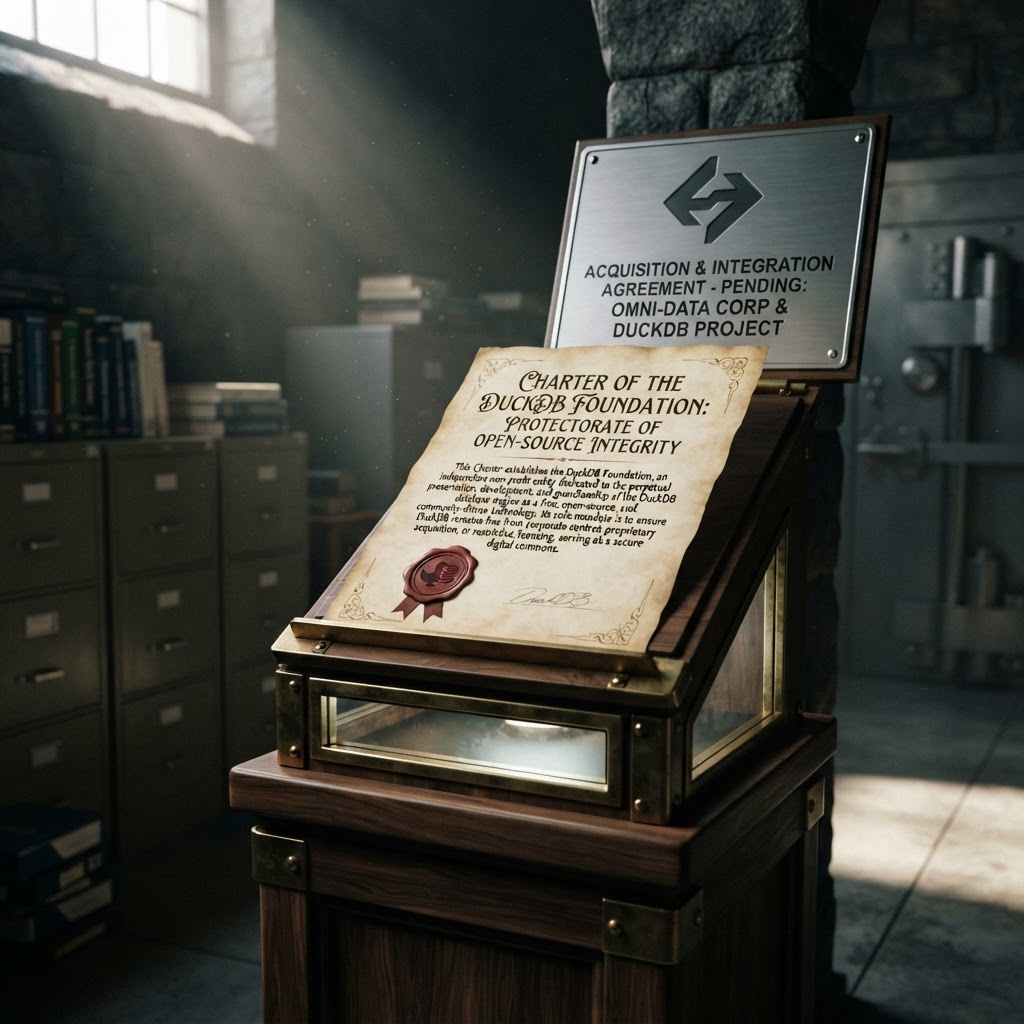
AWS acquiring DuckLabs is easy to interpret as another large cloud provider bringing a popular open-source technology team inside the company. That reading misses the more interesting part. DuckDB was structured years ago so that an acquisition of DuckLabs would not automatically become an acquisition of DuckDB itself. The commercial company is joining AWS. The open-source projects remain MIT licensed. The DuckDB Foundation continues to steward the project and hold the open-source intellectual property. That separation may prove just as meaningful as any database feature DuckDB has shipped. DuckDB did not merely build an open-source database. Its founders built an ownership structure intended to survive changes in the company surrounding it. Original article: https://ducklabs.com/news/2026/08/26/ducklabs-to-join-aws ## The Acquisition Happened After a Very Different Company-Building Path DuckLabs took an unusual route for a database startup. The company was founded a little over five years ago to give the team behind DuckDB a stable home. Venture capital was available. The founders chose not to take it. DuckLabs remained bootstrapped and owned by its founders and development team. That decision gave the company room to grow around the technology rather than around a financing schedule. The team grew to more than 30 people in Amsterdam. DuckDB grew far beyond its early research origins. DuckLabs reports more than one million DuckDB downloads per day. Success then created another problem. The project was growing faster than the company built to support it. That is an interesting inflection point for open-source businesses. A small technical organization can be very good at building software. It may be far less interested in becoming:
text a global sales organization a large support operation a compliance organization a worldwide infrastructure provider a vertical-industry solutions company At some point, growth can force the company to become something its founders never wanted to build. DuckLabs says this tension became increasingly visible. ## The Bottleneck Was No Longer the Database DuckDB's engineering success created demands outside database engineering. Reaching a much larger audience means solving more than query execution. Enterprise adoption can require: text support security review procurement regional infrastructure industry requirements enterprise integrations commercial relationships 24/7 operations None of those problems are small. A database team attempting to solve all of them internally can spend less time building the database. That creates a strange outcome. The commercial success of an open-source project can eventually pull its creators away from the technical work that made the project successful. DuckLabs seems to have recognized that risk. Joining AWS gives the team access to infrastructure, distribution, customers, operational capabilities, and resources without requiring DuckLabs to construct every surrounding business function itself. ## AWS Is Acquiring Scale, Not Ownership of the Open Project This is where the governance model becomes interesting. DuckDB's open-source intellectual property is held by the DuckDB Foundation. That means the commercial company and the open-source project are related, but they are not the same legal object. AWS gains DuckLabs. AWS gains the team. AWS gains deep DuckDB expertise. AWS gains the opportunity to build services around DuckDB, DuckLake, Quack, and related technology. Yet the open-source project remains under the foundation's stewardship. That distinction matters. Without it, an acquisition could create a very different situation: text Company acquired ↓ Project IP acquired ↓ New owner controls license ↓ Community depends on new owner's decisions The DuckDB model looks more like: text Company acquired ↓ Team joins AWS ↓ Foundation keeps project IP ↓ MIT license remains ↓ Community retains open access That is a fundamentally different risk profile. ## Governance Can Be an Engineering Decision Software architecture is usually discussed in technical terms. APIs. Storage engines. Query planners. Extensions. Execution models. Distributed systems. Open-source projects have another architecture: governance architecture. Who owns the intellectual property? Who controls the license? Who decides technical direction? Can one commercial entity close the project? Can contributors participate independently? What happens if the founding company gets acquired? What happens if the founders leave? Those questions can shape the project just as much as technical design. DuckDB offers a useful example of why. The foundation structure was created long before the AWS transaction. Its value becomes much easier to see now. ## Good Governance Creates Optionality
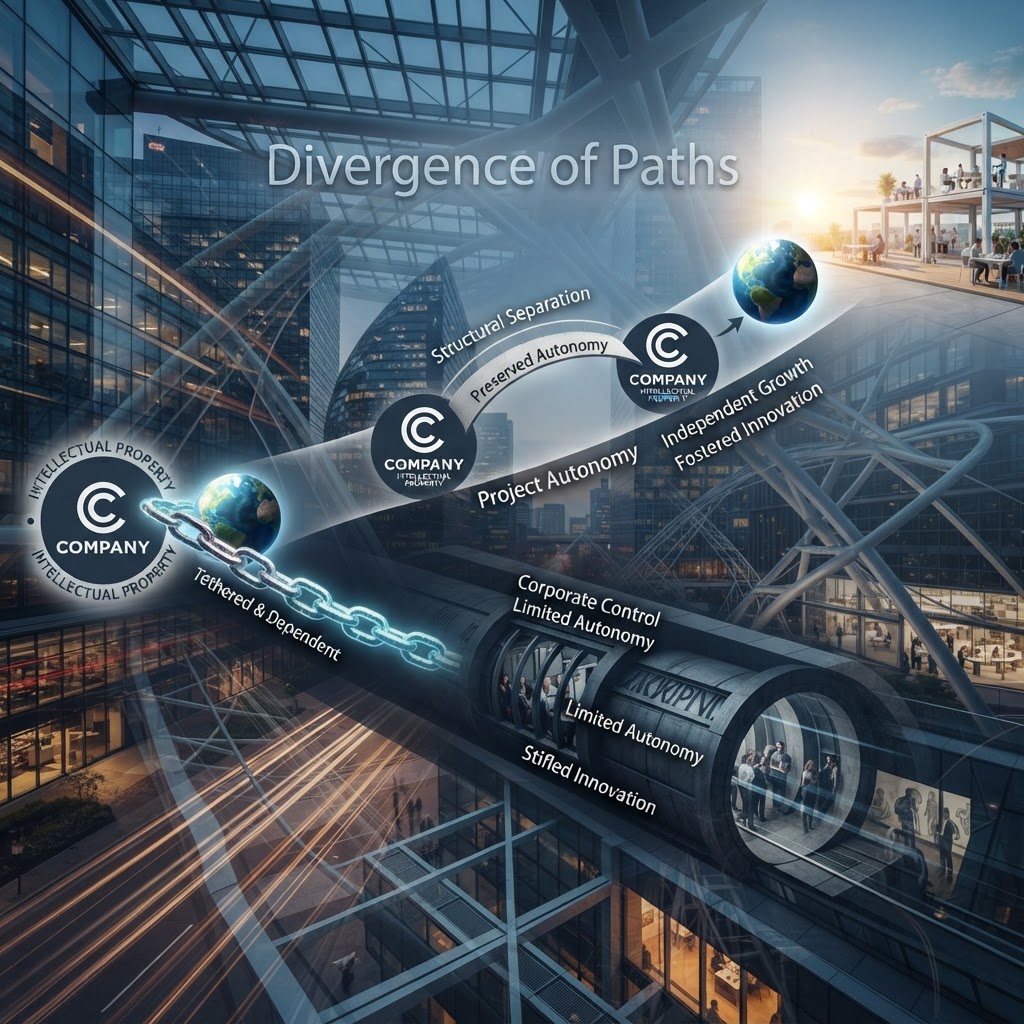
Separating the project from the commercial company gave DuckLabs options. The founders could sell or join another organization without automatically transferring control of the open-source project. That creates flexibility for both sides. DuckLabs can gain scale. AWS can gain expertise and build deeper integration. The community can retain the open project. This does not remove every possible concern. AWS will employ the core DuckLabs team. That naturally gives AWS considerable influence through engineering resources and developer participation. Influence and ownership are not identical. That distinction is worth preserving. ## The MIT License Matters More After an Acquisition Open-source licenses can feel abstract during normal project growth. Their value becomes clearer during ownership changes. DuckDB remaining under the MIT license means developers can continue to: text use it modify it embed it redistribute it build commercial products around it That matters for companies that have already made DuckDB part of their products or architecture. A database is not a disposable dependency. Companies may build years of software around it. The ability to continue using the technology under the same permissive license reduces strategic risk. ## Foundation Ownership Creates a Trust Boundary There is an interesting parallel with software security. Security architects create trust boundaries between systems so one compromise does not automatically become control over everything. Open-source governance can create a similar boundary. Think of: text DuckLabs and: text DuckDB open-source IP as two related assets separated by governance. A commercial transaction affecting one does not automatically transfer the other. That is governance segmentation. The analogy is not perfect, but the architectural idea is useful. Do not place every valuable asset under the same control boundary. ## AWS Gets Something Extremely Valuable Anyway None of this means the transaction lacks strategic value for AWS. DuckDB has become one of the most interesting analytical database technologies of the last several years. Its appeal comes partly from a simple idea: Run analytical queries directly where the data exists. No permanent database server is required for many workloads. No large external warehouse is needed for every analysis. DuckDB can operate embedded inside: text Python applications notebooks developer tools data pipelines local machines applications cloud services That makes it unusually flexible. AWS can now work directly with the team responsible for that technology. ## S3 and DuckDB Are a Natural Combination The AWS relationship becomes even more interesting around object storage. Modern analytical architectures increasingly keep large amounts of data in object storage. S3 frequently becomes the durable layer. Compute can then come and go around it. DuckDB fits that architecture extremely well. A simplified model looks like: text S3 ↓ Parquet / analytical data ↓ DuckDB ↓ Query where needed That removes a traditional requirement to move every dataset into a permanent analytical database before asking questions of it. AWS already sits underneath enormous amounts of enterprise data. DuckDB provides a lightweight analytical engine capable of moving closer to that data. The strategic alignment is obvious. ## DuckLake Makes the Combination More Interesting DuckLabs does not mention only DuckDB. The team will continue working on DuckLake and Quack too. DuckLake extends the broader architectural direction around open analytical data systems. The combination suggests AWS is not merely interested in an embedded SQL engine. It is gaining a team working across a wider "Duck Stack." That can influence future data services in areas such as: text analytics lakehouse architectures object storage local processing embedded databases data interoperability DuckLabs explicitly says the teams plan to use DuckDB, DuckLake, and Quack to help build a new generation of data services. That phrasing deserves attention. ## DuckDB Could Become Infrastructure Users Never See One of the most interesting statements from DuckLabs is the ambition to reach people who may depend on the Duck Stack every day without interacting with it directly. That is how foundational infrastructure wins. Most people using SQLite do not think deeply about SQLite. They use applications that depend on it. DuckDB could follow a similar path in analytics. A developer may never consciously install DuckDB. Their notebook platform may use it. Their cloud service may use it. Their data tool may embed it. Their local AI application may query structured data through it. The technology becomes invisible infrastructure. AWS can accelerate that kind of distribution dramatically. ## The Real Opportunity May Be Embedded Analytics Everywhere Traditional analytical databases assume a destination. Data moves into the database. Queries run there. Embedded analytical engines loosen that assumption. The database can move toward the application. That enables architectures such as: text Data file ↓ Application ↓ Embedded DuckDB ↓ Local analytical query instead of: text Application ↓ Network ↓ Remote warehouse ↓ Query ↓ Network ↓ Application For some workloads, removing those network and infrastructure boundaries can simplify architecture substantially. ## AI Could Make Embedded Analytics More Valuable There is another connection worth watching. AI agents increasingly need structured data. An agent may need to examine: text CSV files Parquet datasets local databases application exports analytical tables Sending every dataset to a cloud warehouse before an agent can reason over it is inefficient. An embedded analytical database gives the agent another option. text User data ↓ Local DuckDB ↓ SQL analysis ↓ Selected result ↓ AI agent This can reduce data movement and give agents structured analytical capabilities close to the source. AWS now has direct access to the team behind one of the strongest technologies for that pattern. ## Open Extensions Could Expand the Ecosystem DuckLabs plans to open the extension stack so extensions signed by other developers and organizations can run in DuckDB. That could become a major ecosystem change. Extensions turn a database from a product into a platform. Third parties can add capabilities without waiting for the core team. A healthy extension ecosystem can produce: text connectors file formats specialized functions data integrations domain-specific analytics AI integrations The project grows beyond what one team can build. AWS backing can give that ecosystem far greater reach. ## The Technical Advisory Board Is Another Governance Signal DuckLabs says the DuckDB Foundation will include a technical advisory board so leading community members can influence technical direction. That move matters after the AWS transaction. The primary development team will now work for one of the world's largest cloud providers. Community governance needs mechanisms that demonstrate the project still has voices beyond its largest corporate contributor. A technical advisory board creates one such mechanism. Its long-term significance will depend on how governance works in practice. The structure itself is encouraging. ## Open Source Does Not Mean Influence Is Evenly Distributed There is still a nuance worth recognizing. Keeping DuckDB MIT licensed and foundation-owned protects openness. It does not mean AWS will have no outsized influence. The DuckLabs development team will work inside AWS. Engineering resources matter. Roadmap effort matters. Developer time matters. AWS can fund work at a scale few community contributors can match. The relevant question is not whether AWS has influence. It clearly will. The question is whether the governance structure keeps that influence compatible with a broader ecosystem. That will become visible over time. ## The Community Should Watch Actions, Not Just Promises The strongest signals will come from what happens after the acquisition. Does outside contribution remain healthy? Do competing cloud providers continue integrating DuckDB comfortably? Does the extension ecosystem become more open? Does foundation governance gain meaningful participation? Do technical decisions remain useful beyond AWS services? Does DuckDB remain easy to run everywhere? Those outcomes matter more than acquisition-day language. Open-source trust compounds slowly and can disappear quickly. DuckLabs clearly recognizes that. ## There Is a Lesson Here for Other Open-Source Founders The DuckDB story creates a useful template. If the goal is to build an open project that can survive commercial changes, governance should be addressed early. Not during the acquisition. Not after investors arrive. Not after a licensing dispute. Early. Questions worth asking include: text Who owns the IP? Can the company change the license alone? What happens if the company is sold? What rights does the foundation hold? How can outside contributors influence direction? Can competitors safely build products around the project? Those decisions can determine whether a project remains an ecosystem or becomes a feature inside whoever acquires the founding company. ## Open Source Can Increase Acquisition Value There is a counterintuitive lesson here too. Keeping the open project independent does not necessarily make the company less valuable. It may make the ecosystem larger. Companies adopt technology more confidently when they believe it will remain accessible. That drives usage. Usage builds community. Community builds integrations. Integrations create commercial opportunities. The resulting ecosystem can make the core team extremely valuable to a company such as AWS. In that sense, openness does not sit opposite commercial value. It can create it. ## AWS Is Buying the Team Behind the Momentum DuckLabs says DuckDB now sees more than one million downloads per day. The technology already has enormous organic distribution. AWS does not need to manufacture interest. It can accelerate an existing movement. That may explain why keeping the project open makes strategic sense for AWS too. Closing or tightly controlling DuckDB could damage the ecosystem that made the technology attractive in the first place. The larger opportunity is making DuckDB more useful everywhere, then building AWS services that benefit from that ubiquity. ## The Bigger Lesson The DuckLabs transaction is easy to summarize: AWS acquired DuckLabs. The team stays together. DuckDB stays open source. That misses the deeper story. Years earlier, DuckDB's creators made a structural choice. They separated the open-source project's ownership from the commercial organization built around it. Now that architecture is being tested. DuckLabs can join AWS. The founders and engineers can gain access to much greater resources. AWS can gain one of the strongest teams in analytical databases. The project can remain MIT licensed. The foundation can retain stewardship. The ecosystem can continue building around it. That is not an accident. It is the result of governance decisions made before anyone knew exactly how valuable those decisions would become. Software engineers spend enormous amounts of time thinking about systems that survive failure. Open-source communities should think the same way about ownership. Companies change. Founders leave. Markets shift. Acquisitions happen. A project built to survive those transitions has a better chance of lasting longer than the company that originally funded it. DuckDB may now become one of the strongest examples of that principle. ### Original Source Mark Raasveldt and Hannes Mühleisen, DuckLabs, “DuckLabs to Join AWS, Projects to Remain Open Source,” August 26, 2026. https://ducklabs.com/news/2026/08/26/ducklabs-to-join-aws