Back to Stream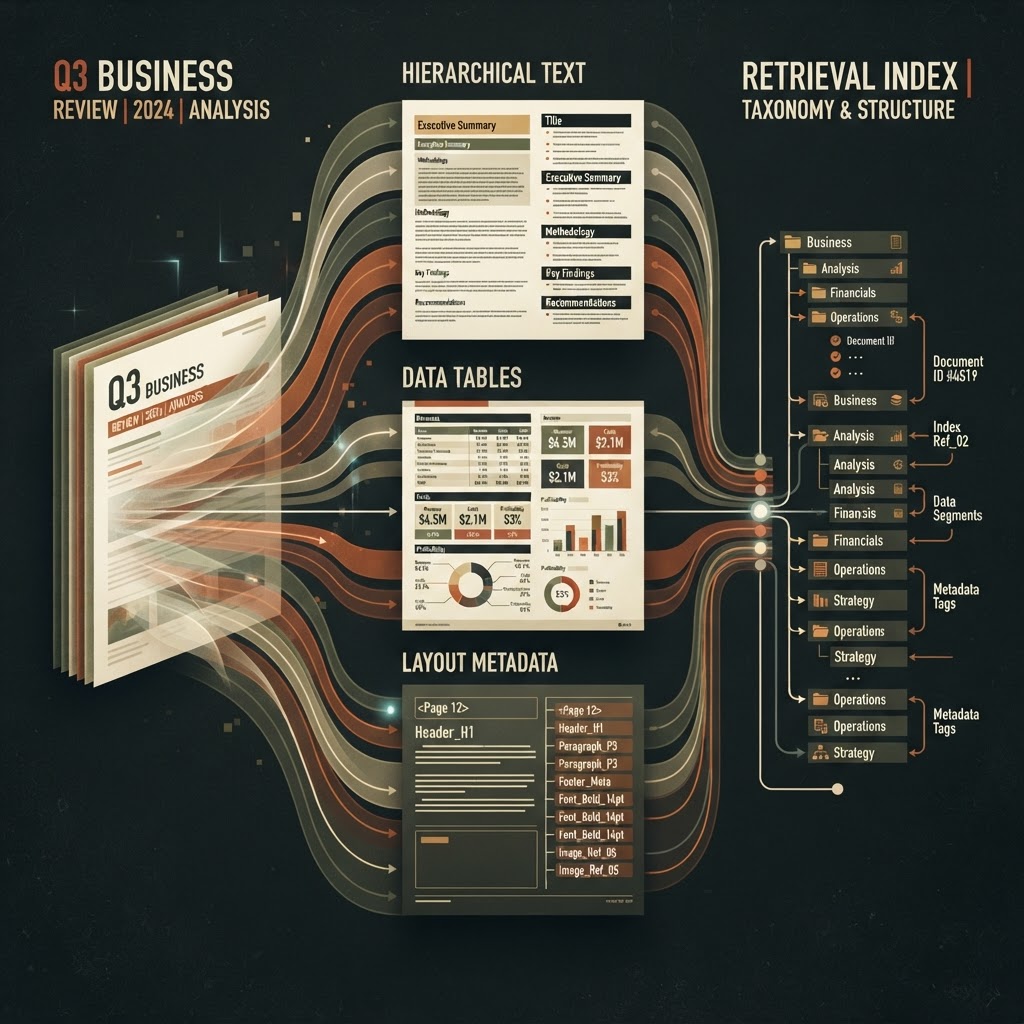
Document AISeptember 24, 202695% synthesized
Document Parsing Defines the Semantic Ceiling of Retrieval Architectures
Modern document processing has evolved from simple character recognition into a fundamental retrieval infrastructure that determines the success of downstream RAG and agentic workflows. By prioritizing structural integrity during parsing, organizations can ensure that LLMs receive high-fidelity representations rather than corrupted data.
The Shift from Preprocessing to Infrastructure OCR was once a utility. You took a scan, extracted the text, and moved on. That model is now obsolete. Modern document AI requires more than just characters; it requires structure. The new standard demands the preservation of reading order, headings, tables, equations, and complex layout relationships. Furthermore, this must occur at a scale capable of supporting millions of pages within search, retrieval augmented generation, and agentic pipelines. When document processing happens at this volume and precision, it ceases to be a background task and becomes the primary infrastructure of the retrieval stack. ## The Fallacy of Downstream Recovery A common failure point in modern AI systems is the assumption that poor input can be corrected by advanced downstream components. Consider a PDF containing a financial table. A traditional parser might flatten the columns into a single stream of text. Technically, every character is present, but semantically, the relationship between values and categories is destroyed. When an LLM receives this flattened output, it must struggle to reconstruct the structure. Developers often respond to these failures by tweaking embedding models, adjusting chunking strategies, or replacing rerankers. Yet, the root cause is often the initial parsing. If the structure is lost at the beginning, a perfect embedding model cannot recreate it. If a table is corrupted into a wall of text, no amount of reranking can restore the logical grid. Parsing quality establishes an immutable ceiling on retrieval performance. ## Document Models as Compilers The emergence of models like jina-ocr-v1 marks a departure from traditional character recognition. These systems do not merely identify glyphs; they translate document pages into structured outputs in a single pass. This process is better described as a document compiler than a standard OCR engine. By outputting Markdown for text, HTML for tables, and LaTeX for formulas, these models provide a machine-readable abstraction that is optimized for LLM consumption. This represents a fundamental shift in the abstraction layer of document processing. The output is no longer just a string of characters; it is a structured data object designed for immediate integration into an index.

The Economics of Active Parameters Model efficiency is no longer a luxury but a requirement for enterprise-scale document pipelines. Massive models are useful, but for high-throughput environments, the number of active parameters per token is the more critical metric. Mixture of experts architectures allow for models with billions of total parameters to activate only a small fraction during inference. For an organization processing hundreds of millions of pages, this architectural efficiency dictates the feasibility of the entire operation. Latency, GPU utilization, and power consumption become primary constraints. In this context, page throughput is a more meaningful success metric than raw token generation speed. A parser that produces a concise, structured output using fewer tokens per page will inherently outperform a faster but less intelligent model. ## Speculative Decoding and Deterministic Output Document parsing benefits significantly from the deterministic nature of its task. Unlike creative writing, where multiple valid outputs may exist, a transcription system is expected to yield one correct, verifiable output. This property makes speculative decoding highly effective. Smaller draft models can predict the output, while the larger main model verifies the result. This approach maintains high accuracy while significantly increasing speed. Systems that utilize mechanisms like FastMTP can deliver the quality required for enterprise document pipelines without the silent degradation of numerical data. Reliability is the prerequisite for any high-volume retrieval infrastructure. ## The Multiplier Effect on Downstream Costs The choice of a parsing system influences four distinct cost centers within an organization. First, the compute cost involved in processing a document corpus. Second, the storage cost associated with the resulting structured representation. Third, the embedding cost driven by the token count of the parsed document. Finally, the retrieval quality, which determines the overall utility of the system. A high-quality parser functions as a cost multiplier for RAG applications. By preserving structure, it enables efficient chunking and cleaner embeddings, which in turn leads to more successful retrievals. When viewed through this lens, document parsing is not an optional preprocessing checkbox. It is an essential component of the retrieval strategy. ## The Interface of Markdown and Structured Representation Markdown has emerged as a standard intermediate representation because it serves as an effective API contract between visual documents and machine consumers. It is human-readable, structurally expressive, and easy to index. When combined with HTML tables and LaTeX, it creates a robust framework for passing data to LLMs. This interface simplifies the downstream logic significantly. Agents, in particular, rely on this structural fidelity to perform complex operations like comparing termination clauses or reconciling figures across hundreds of pages. If the parser fails to represent the document hierarchy correctly, the agent will inevitably produce flawed results. The reliability of an agent is strictly limited by the context it receives. ## Conclusion: Moving the Retrieval Stack Upstream The competitive advantage in document-heavy AI is moving toward the very beginning of the pipeline. Search engineers have long focused on analyzers, vector indexes, and reranking, yet these components are helpless if the initial data ingestion is faulty. For documents, the retrieval stack effectively begins with the translation from pixels to structured code. We must stop treating OCR as a peripheral task and start managing it as the foundation of our AI infrastructure. The best retrieval system in the world cannot recover information that was discarded during the first step of the process. For any organization building a serious document intelligence platform, the most consequential architecture decision will be how it handles the initial parse.
Sources & Synthesis