Cloud Marketplaces Are Redefining the AI Production Lifecycle
Modern AI infrastructure success depends less on query latency and more on organizational friction, as cloud marketplaces evolve into critical application delivery paths. Organizations must now treat procurement and governance as core architectural components to ensure rapid deployment of complex AI stacks.
Infrastructure Competition Has Moved Beyond Performance
For years, the discourse surrounding AI infrastructure focused almost exclusively on technical metrics. Engineers and architects obsessed over vector search latency, recall precision, hybrid retrieval strategies, and the cost per query. These metrics are undeniably important, but they represent only half of the equation for production success. There is a secondary, often ignored, layer of architecture that determines whether a promising model ever reaches a live environment: the administrative path required to acquire, deploy, govern, and pay for the technology.
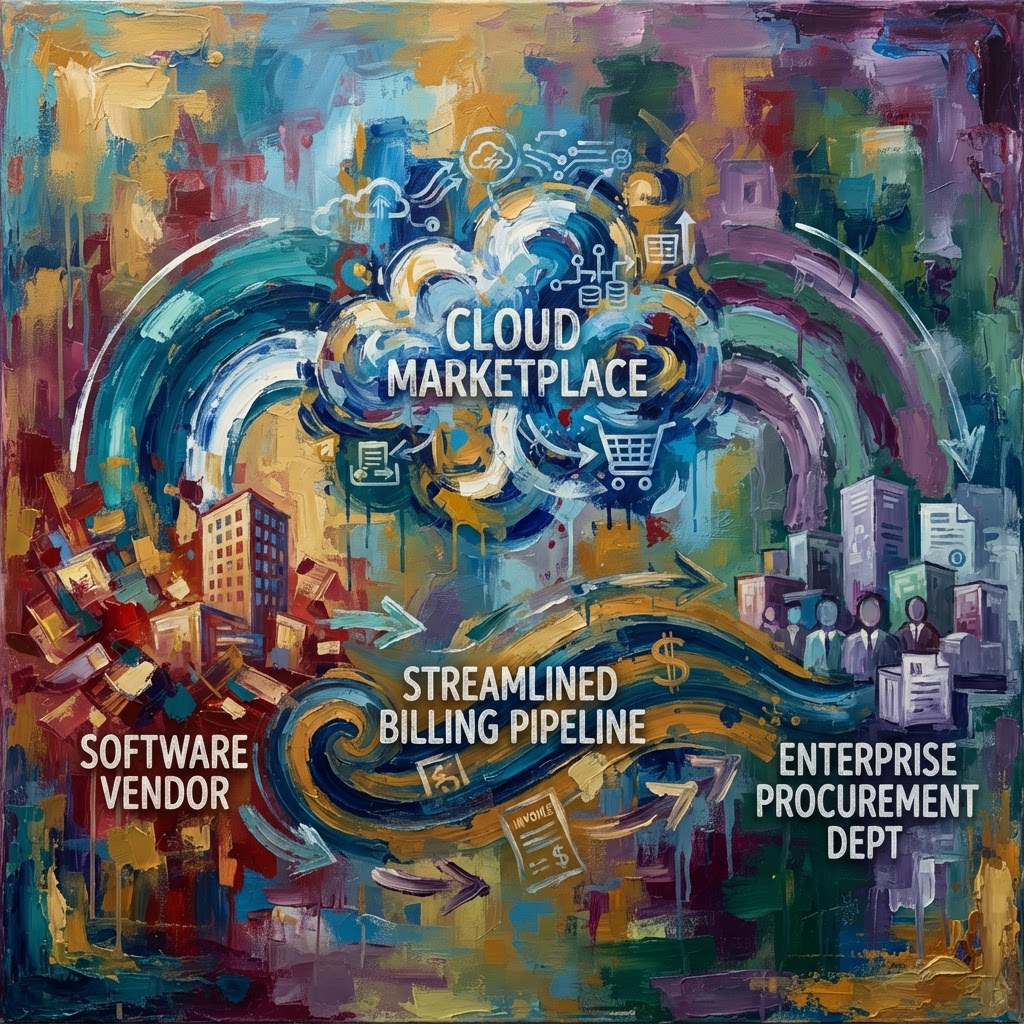
Cloud marketplaces are fundamentally shifting from simple software catalogs into vital components of the application delivery pipeline. As enterprises build increasingly complex AI stacks, the ability to bypass traditional procurement hurdles has become as critical as the speed of a vector database index. This shift represents a transition in how we define product integration, moving from software APIs to procurement and billing APIs.
Procurement as Architectural Friction
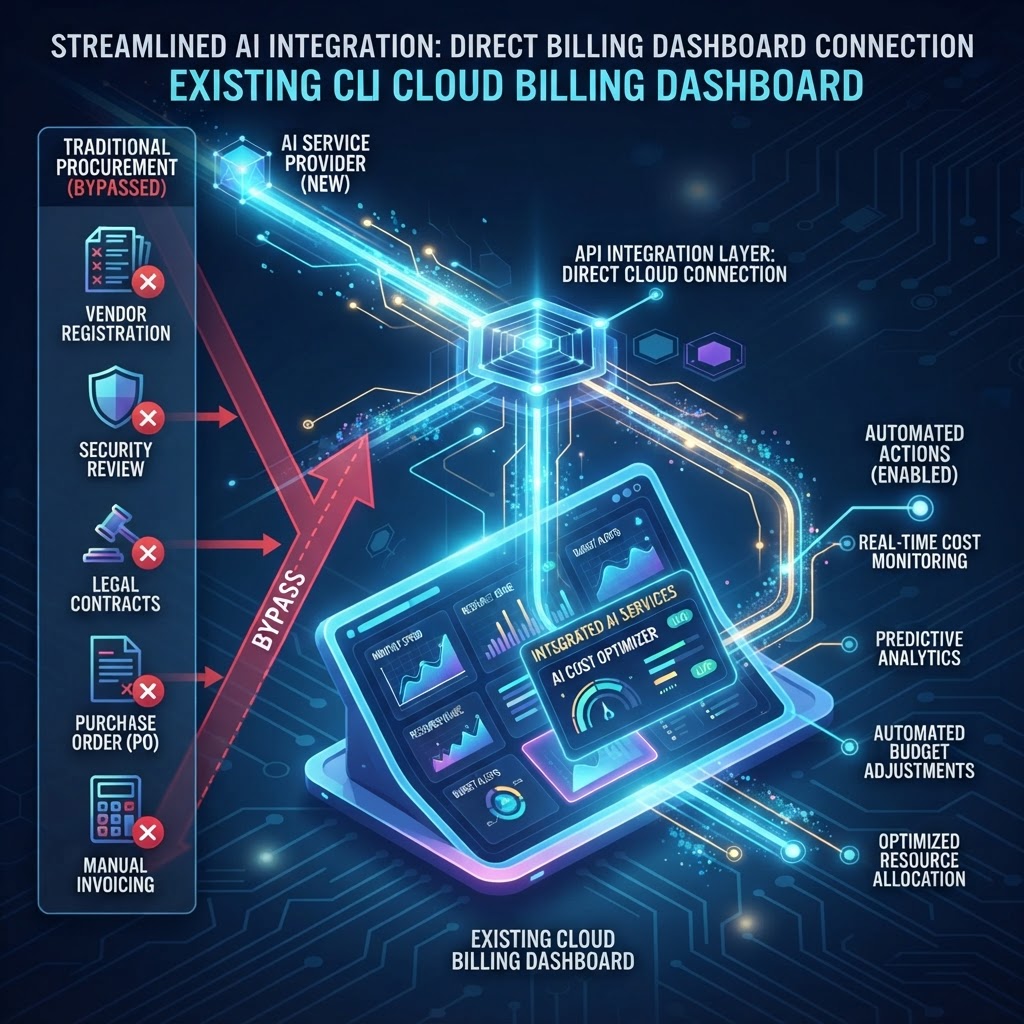
Consider two technically identical AI platforms. Platform A requires a new vendor agreement, a separate billing relationship, a custom security review, and an isolated procurement workflow. Platform B is available through the cloud provider the company already uses, appears on the existing cloud invoice, aligns with established security controls, and launches through familiar infrastructure automation. While the runtime technology might be identical, the organizational cost of Platform A is significantly higher.
This gap is often the primary reason AI experiments stall between prototype and production. When a team needs to move from a developer laptop to a governed, scalable service, they frequently find that the commercial and operational model is a greater obstacle than the technical architecture. Architecture diagrams often ignore procurement, yet production systems depend entirely on it. If an organization cannot effectively pay for or secure a piece of technology, it simply does not exist in their stack.
The Cloud Bill as an Integration Surface
Integration traditionally implies software interoperability, usually facilitated by REST APIs or gRPC interfaces. However, enterprise adoption requires a different set of APIs, which include budget mapping, procurement verification, billing consolidation, and identity governance. When Elastic launches a service like the Azure Native Service, it is not merely providing a software product; it is creating a financial integration.
By allowing costs to flow through an existing Azure subscription, the service removes the need for separate billing cycles and administrative overhead. Google Cloud achieves a similar outcome by integrating marketplace charges directly into its Cloud Billing system. This strategy reduces organizational latency. For an enterprise, an integration that saves a team two months of vendor onboarding is often more valuable than an integration that saves two milliseconds of search latency.
Marketplaces Leverage Financial Commitments
One of the most powerful drivers of this trend is the cloud consumption commitment. Hyperscalers like Microsoft and Google encourage large enterprises to commit to specific levels of cloud spending in exchange for discounts. These Microsoft Azure Consumption Commitments (MACC) or equivalent Google Cloud programs often act as a gravity well for purchasing decisions. If a team is choosing between an independent AI vendor and a solution available on a cloud marketplace, the latter often wins simply because it allows the company to satisfy its existing financial commitments.
This changes the evaluation criteria for new technology. Decision makers no longer just ask if a product is the best in class. They now ask if the product can be purchased using committed funds, if it avoids a new procurement cycle, and if it maintains existing billing consolidation. These factors have become as significant as performance metrics when determining which architecture is practical for long-term deployment.
Building Distribution Architecture
For vendors, this evolution necessitates a move toward distribution architecture. Marketplace strategy can no longer reside solely within the sales department. Engineering, product, security, and developer experience teams must collaborate to treat the marketplace listing as a first class product surface.
A robust marketplace integration must account for account identity, entitlement mapping, deployment automation, regional availability, private networking, and support routing. If these systems are not tightly integrated, the marketplace listing remains a disconnected storefront. However, when these components are unified, the marketplace becomes a seamless, native entry point that lowers the barrier to adoption. The best onboarding path is not the one with the most attractive signup form, but the one that eliminates the context switches between initial interest and a functioning, production-ready workload.
Governance and Self-Service Tension
Marketplaces offer a unique solution to the classic tension between developer agility and enterprise governance. By using curated private marketplaces, security and procurement teams can define an approved boundary within which developers can operate. This creates a model of centrally governed, locally activated infrastructure. It avoids the binary trap of either stifling innovation with ticket-based procurement or introducing risk through unrestricted, rogue spending. It allows the enterprise to move quickly while maintaining a clear audit trail and cost control.
The Need for Continued Architectural Scrutiny
Despite the clear benefits of marketplace procurement, there is a risk that frictionless purchasing could mask architectural deficiencies. A smooth marketplace experience might make products appear interchangeable when they are vastly different in terms of data portability, egress behavior, and vendor lock-in. Buyers must remain vigilant. A convenient purchasing path should reduce administrative friction, not critical architectural scrutiny. As infrastructure becomes easier to provision, the responsibility to verify availability guarantees, pricing dimensions, and long-term data ownership becomes even more paramount.
A New Benchmark for AI Adoption
Perhaps it is time to redefine how we measure the speed of infrastructure. We should shift the benchmark away from the moment of installation and toward the moment of discovery. The clock should start when a developer decides to evaluate a product and stop when the first production-representative query runs inside a governed, paid environment. This encompasses the entire journey from discovery to deployment. For many organizations, shaving weeks off this path is the difference between leading with AI and falling behind. The next generation of AI infrastructure will certainly need excellent technical capabilities, but its success will be defined by how quickly the surrounding organization can say yes.