Beyond Version Numbers: Why Patching Elastic Requires a Component-Aware Strategy
Modern enterprise platforms like Elastic are complex ecosystems where a single version number fails to capture your true security posture. Effective patch management requires mapping specific vulnerabilities to your unique configuration of components, deployment modes, and access boundaries.

The Flaw in Simplistic Patching
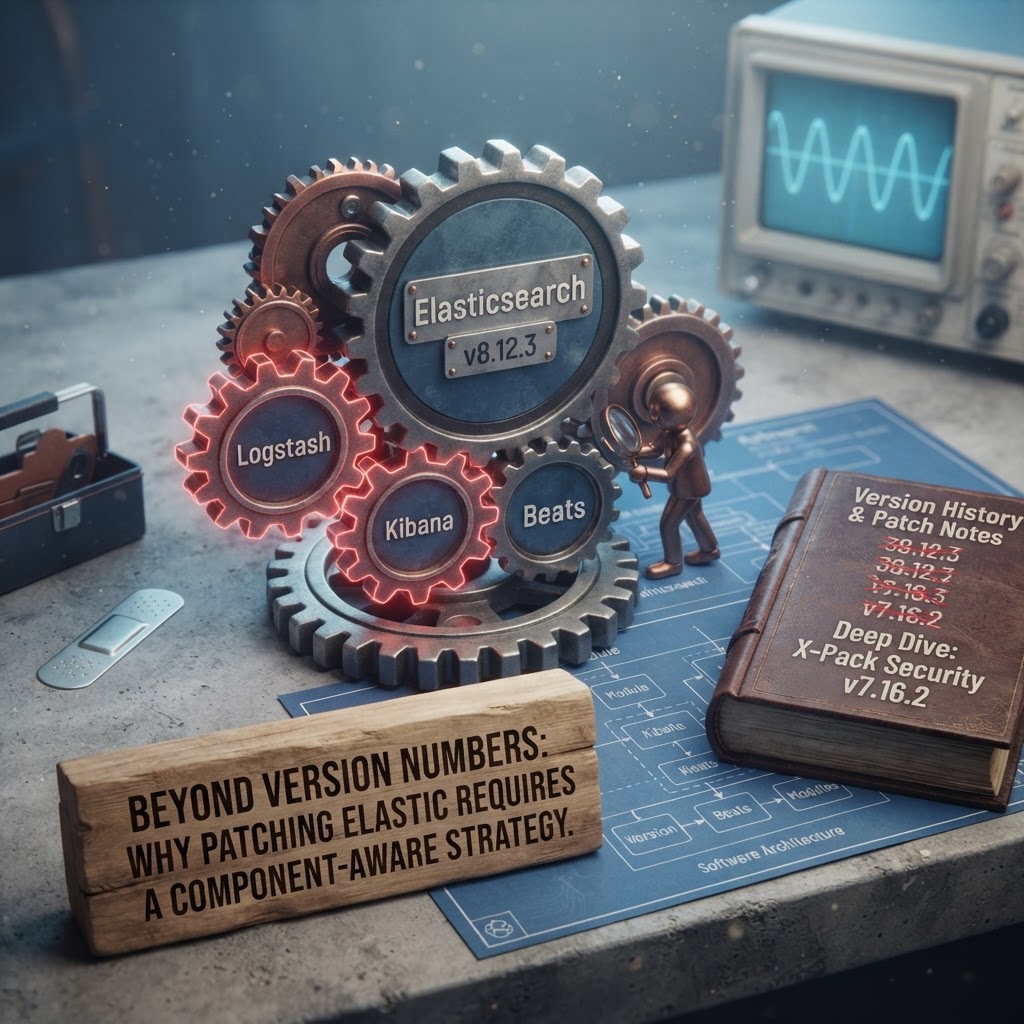
Security teams often treat patching as a straightforward version number problem. You find the affected version, install the latest release, and move on. However, recent security announcements from Elastic provide a vital reminder that modern, modular platforms make this process far more complicated. An Elastic deployment is rarely just a single binary. Instead, it is a complex ecosystem that can include Elasticsearch, Kibana, Fleet, Elastic Agent, Beats, the APM Server, and ECK, with each component maintaining its own unique security boundary and upgrade path.
The real security question today is not whether you are running the latest version of Elastic. The actual question is whether every exposed component in your stack is on a version that remediates the vulnerabilities relevant to your specific configuration. If you rely on simple version checks, you are likely leaving critical gaps in your defense.
Kibana and Fleet: High-Stakes Authorization
One of the most significant recent advisories, ESA-2026-140, highlights an incorrect authorization issue in Kibana. Elastic reported that integration package cluster privilege declarations were not properly validated before credentials were created for enrolled Elastic Agents. A user with standard Fleet management permissions could potentially cause agents on a specific policy to receive credentials with elevated Elasticsearch cluster privileges, which might eventually lead to full cluster administration. This issue is rated as High with a CVSS score of 8.1.
Authorization bugs are particularly dangerous because the system is performing a technically valid operation, just with the wrong level of authority. Nothing crashes, and no alerts may trigger for unusual behavior. In this case, the risk is not that an anonymous internet user becomes an administrator. Instead, the vulnerability highlights that even authenticated accounts can be misused or compromised. Because Fleet is enabled by default in Kibana, this is not a theoretical corner case. It is a configuration that exists in nearly every deployment.
Context is King in Vulnerability Management
Another advisory, ESA-2026-150, affects Elastic Agent on Windows systems installed in unprivileged mode. This vulnerability allows a local user to potentially manipulate binaries to execute code as SYSTEM. However, the critical qualifier is the deployment method. Default privileged Windows installations are not affected, and Linux or macOS systems remain secure. This proves that version numbers alone provide an incomplete picture of your risk. You must understand how your components are deployed in the real world to prioritize effectively.
Similarly, Elasticsearch has its own independent security path. For instance, ESA-2026-47 addresses a resource allocation issue that allows a privileged user to trigger excessive memory consumption. The fix for this specific issue may not align with the fixed version for a related Kibana vulnerability. If your patch management strategy involves simply clicking an 'Update All' button without understanding these dependencies, you are flying blind.
Moving Toward Security Engineering
A mature patch plan must treat the platform as a dependency graph. For every environment, you should maintain an inventory that includes the specific versions of Elasticsearch, Kibana, Beats, and agents, as well as the integration packages in use and the active authentication boundaries. Without this map, you are forced to reason from memory, which is exactly where security failures occur.
When prioritizing your work, look beyond the CVSS score. CVSS is a helpful metric, but it is not a replacement for contextual risk assessment. Evaluate vulnerability impact by calculating: Severity times Reachability times Privilege requirements times Business impact times Deployment prevalence. This formula will help you identify which components to patch first based on actual exposure rather than arbitrary rankings.
The Cloud Tradeoff
Elastic has noted that its Cloud Serverless offerings are often remediated before public disclosure due to their continuous deployment models. This highlights a fundamental tradeoff between managed and self-managed infrastructure. Managed services collapse the operational burden of detecting advisories, mapping assets, and validating upgrades. Self-managed systems offer total control, but that control comes with the professional responsibility to manage the entire patch lifecycle.
The recent Elastic advisories are not just a list of CVEs to clear. They are a reminder that enterprise platforms have multiple security surfaces. Your goal should be to understand which components you are running, how they are configured, and which security boundaries each advisory affects. Answering these questions before the next alert arrives is the defining difference between simple patch management and true security engineering.