Beyond the Token: Building a Financial Language for Enterprise AI
Enterprise AI is shifting from a focus on raw technical capability to a new era of economic accountability and unit cost management. The newly formed Tokenomics Foundation aims to bridge this gap by establishing standardized frameworks for linking AI consumption to tangible business outcomes.

Enterprise AI has reached a pivotal, if somewhat awkward, stage of its development. While companies have mastered the art of measuring token usage and calculating associated costs, they often struggle to answer the question that truly matters to executives: what did the AI produce that was actually worth the investment? This disconnect between consumption and value is precisely the problem the Linux Foundation's new Tokenomics Foundation intends to solve. By launching with 30 industry members, the organization aims to create open standards, benchmarks, and shared terminology for AI economics. While this could easily be dismissed as a simple billing standardization effort, the reality is much more significant. AI is beginning to develop its own unique financial operating model.
Tokens have become the most visible unit in AI economics. Providers charge for them, engineering teams monitor them, and procurement teams use them as a primary basis for comparison. Yet, a token is an unusual financial unit. Unlike a kilowatt hour that represents consumed electricity or a gigabyte that represents stored data, a token represents a fragment of language or reasoning. Its business value varies wildly based on context. One million tokens used to generate disposable marketing drafts compared to one million tokens used to automate a high-value compliance process represent identical consumption but radically different economic outcomes. Token count is useful as telemetry, but it is not sufficient as a business metric.
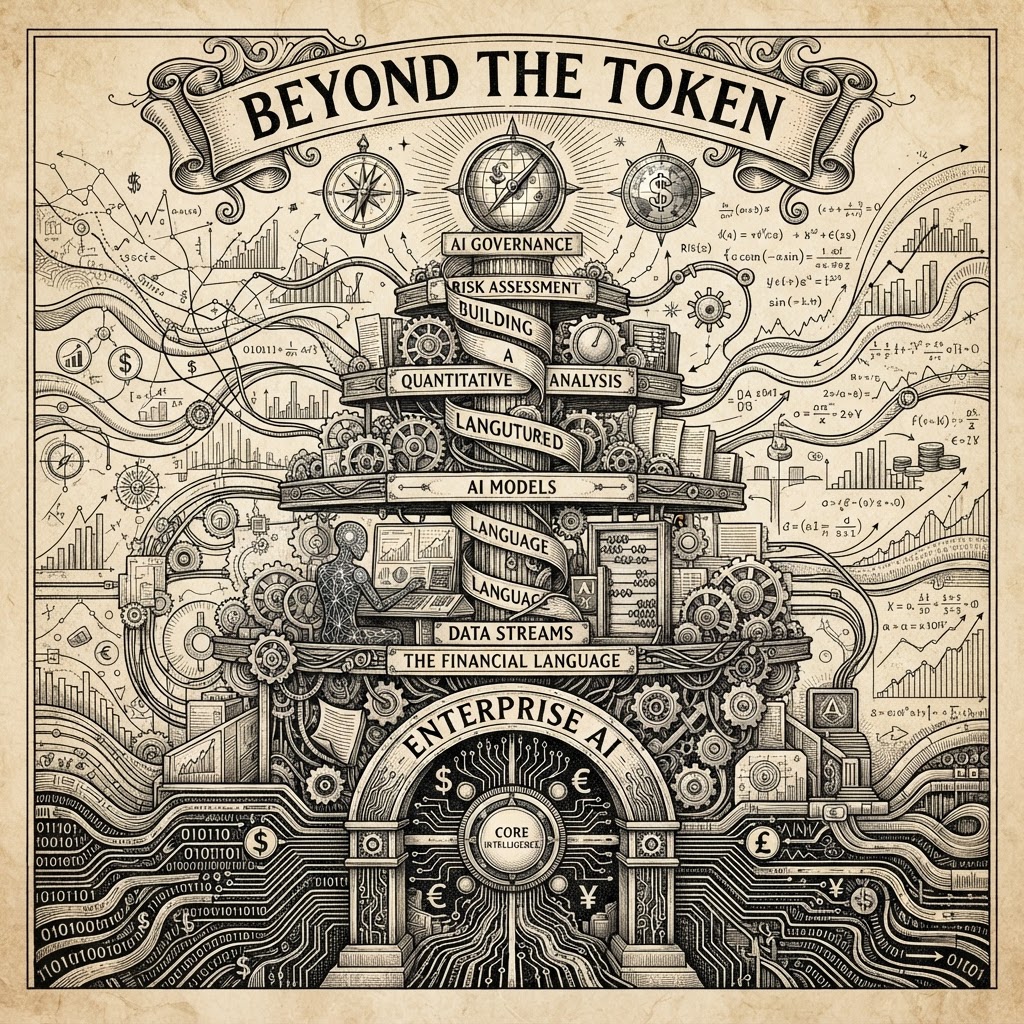
The Foundation describes tokens as a consistent atomic unit that can help organize the broader AI cost structure. Tokens do not need to represent the total cost perfectly to be valuable. They may simply provide the common unit around which other costs can be attributed. Consider the complexity of a modern AI transaction: an input request leads to model inference, reasoning, tool calls, database queries, storage, output, and potentially human review. The model bill captures only one small part of this chain. The true economic cost spans compute, retrieval, network activity, orchestration, and human validation. In this ecosystem, the token becomes a meter placed near the middle of a much larger and more complex system.
The industry roadmap includes a transition toward cost to serve, expressed as cost per call rather than cost per token. This shift could be transformative. Suppose two systems perform the same customer support task. System A uses 8,000 tokens at a cost of $0.09, while System B uses 35,000 tokens at $0.31. At first glance, System A is the obvious winner. However, if System A resolves only 48 percent of requests without escalation while System B resolves 91 percent, the financial calculation changes. The organization should stop asking which model uses fewer tokens and start asking what a successful outcome costs. Cost per resolved ticket, cost per qualified lead, or cost per closed security alert are the metrics that will eventually define AI maturity.
The most promising value framework involves measuring the share of work completed without human involvement compared with the cost of the existing legacy process. Statements like employees are faster or teams are more productive are difficult to audit. A stronger metric is the percentage of work completed without human intervention, paired with the cost of the previous process. For example, if an old workflow required 12 minutes of analyst time, and an AI workflow completes 85 percent of the work automatically for a cost of $0.42, finance and engineering teams finally have a shared language to discuss progress.
Cloud computing experienced a similar maturity cycle. Initially, companies celebrated flexibility, but eventually, the bills arrived, leading to the rise of FinOps to connect engineering decisions with financial accountability. AI is entering a comparable phase, but with a critical difference. Cloud resources produce infrastructure, whereas AI systems produce decisions, content, and analysis. Consequently, cost optimization without quality measurement can create false savings. The cheapest model may be the most expensive choice if it fails three times as often or necessitates extensive human review. By moving toward economic observability, where architects design systems to track business outcomes alongside latency and token consumption, organizations can ensure they are not just optimizing for cheap interactions, but for valuable ones. Ultimately, the Tokenomics Foundation is building the bridge between machine intelligence and business reality, helping companies stop asking how much they are spending and start asking how efficiently they are turning AI into value.