Beyond the Search Bar: How Retrieval is Becoming the Engine of AI Reasoning
Modern artificial intelligence applications are evolving to treat search as a foundational reasoning primitive rather than just a user interface feature. By separating data retrieval from model analysis, developers are building more efficient, scalable, and debuggable systems for complex tasks like entity matching and security governance.
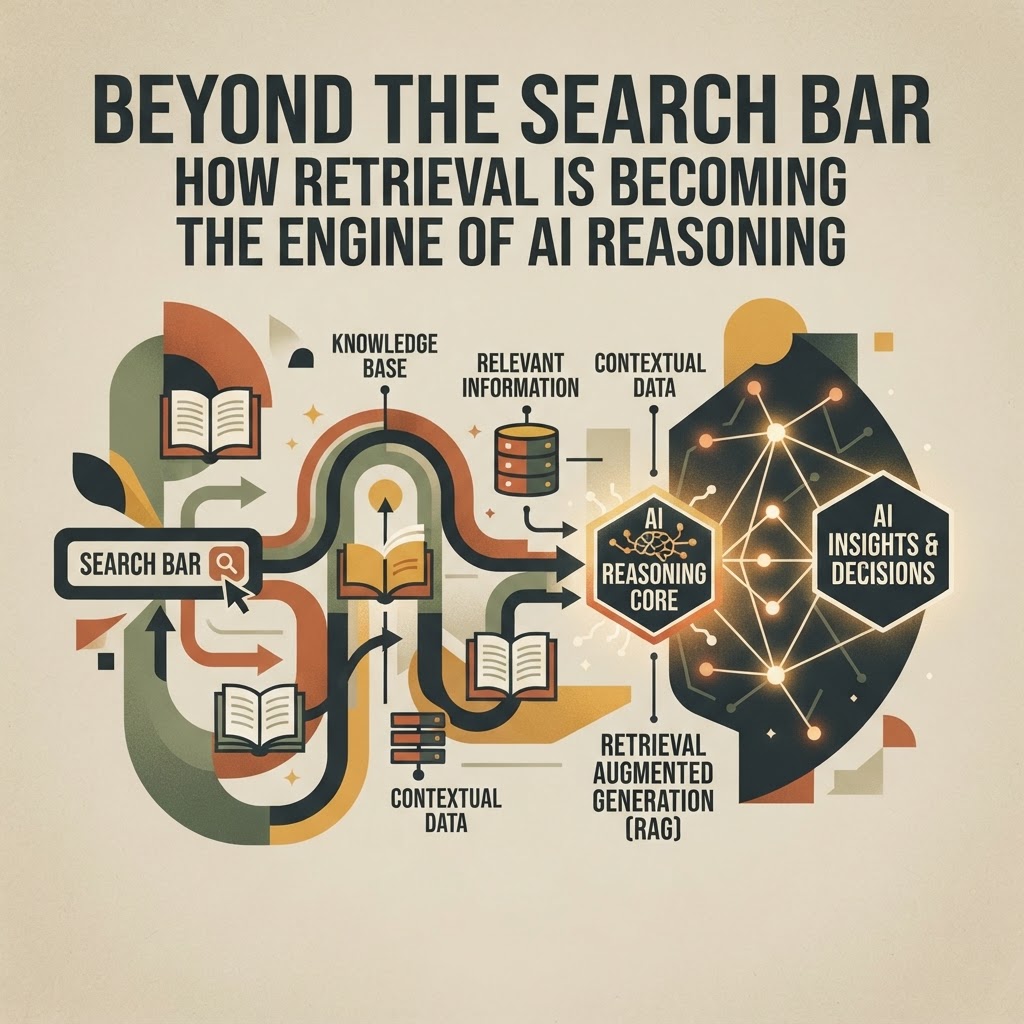
The Hidden Evolution of Elasticsearch
One of the most compelling signs of where Elasticsearch is heading comes from the community rather than formal product announcements. Recent projects in the Elastic ecosystem, such as the upcoming Austin Elastic Community Night, demonstrate applications ranging from AI powered data security governance to semantic entity matching using Elasticsearch and Claude. While these use cases appear distinct on the surface, they share a critical architectural challenge: finding the right information when exact keyword matching is no longer sufficient. This problem has become the central pillar of modern AI system design.
Search as a Reasoning Primitive
Traditional search assumes that a user knows exactly what they are looking for and provides a string of terms to match against an index. Modern AI applications operate under a different paradigm. An autonomous agent may need to determine if two companies are the same entity despite variations in their names. A security platform must discover complex relationships among files, identities, and permissions to enforce policy rules. In these scenarios, search is no longer a tool for a human to find a document. Instead, search is an internal reasoning capability utilized by a software agent. This transition marks a significant shift in how we build intelligent infrastructure.
Solving the Entity Matching Puzzle
Consider the challenge of entity matching in a global business context. A system might need to compare records from sanctions lists against internal registries. A standard keyword search struggles when comparing entries like Acme International Holdings LLC against Acme Intl. Holdings. While a human immediately recognizes the connection, a literal matching engine often fails due to abbreviations, transliterations, spelling differences, and language nuances.

By leveraging semantic retrieval, developers can move beyond identical word matching. The system asks whether two representations are meaningfully similar. When combined with a large language model like Claude, the architecture becomes significantly more powerful. The workflow typically involves four steps: collecting external data, normalizing it into an index, retrieving likely matches semantically, and providing those candidates to an AI model for final reasoning. In this flow, search narrows the problem space, and AI provides the evaluation. This pattern is becoming a gold standard for reliable AI.
The Logic of Retrieval Before Reasoning
For builders of AI applications, there is a vital lesson in efficiency. Large language models are exceptional reasoning engines, but they are not designed to search through massive datasets in real time. Feeding an LLM millions of records is computationally expensive, slow, and often results in lower accuracy due to context window limitations. Retrieval acts as a necessary filtering layer. If a system must determine which company matches a record, search can reduce the candidate list from millions to twenty. The model then performs its reasoning on that refined set. This approach is faster, cheaper, and significantly easier to control.
Infrastructure for Security and Governance
Data security governance presents a similar structural challenge. Organizations manage vast volumes of information, and security teams must constantly track sensitive data, access permissions, and policy compliance. This requires indexing and connecting massive amounts of metadata. Once this data is indexed, search becomes the bedrock for reporting, investigation, and AI assisted analysis. The end user may never label the interface as search. They might experience a security dashboard, a conversational AI assistant, or an automated investigation workflow. In this context, Elasticsearch functions as the invisible, high performance infrastructure supporting the application layer.
Debugging the AI Stack
This architecture creates a repeatable pattern: data sources lead to ingestion, which leads to indexing, then semantic retrieval, model reasoning, and finally an application action. Beyond performance, this separation improves observability. If a system produces a bad answer, developers can easily determine if the fault lies in the source data, the indexing process, the retrieval ranking, or the model reasoning itself. This modularity is essential for building production grade AI systems that are reliable and easy to maintain. The search engine does not need to replace the model, and the model does not need to replace the search engine. The most resilient systems combine them to leverage the unique strengths of each component.