Beyond the Chatbot: Elastic Agent Builder as an Operational Workspace
Elastic Agent Builder is evolving from a simple conversational interface into a robust operational workspace that integrates data analysis, visualization, and workflow execution. This shift effectively bridges the gap between AI reasoning and actionable infrastructure management within the Elastic ecosystem.

The Shift Toward Operational Integration
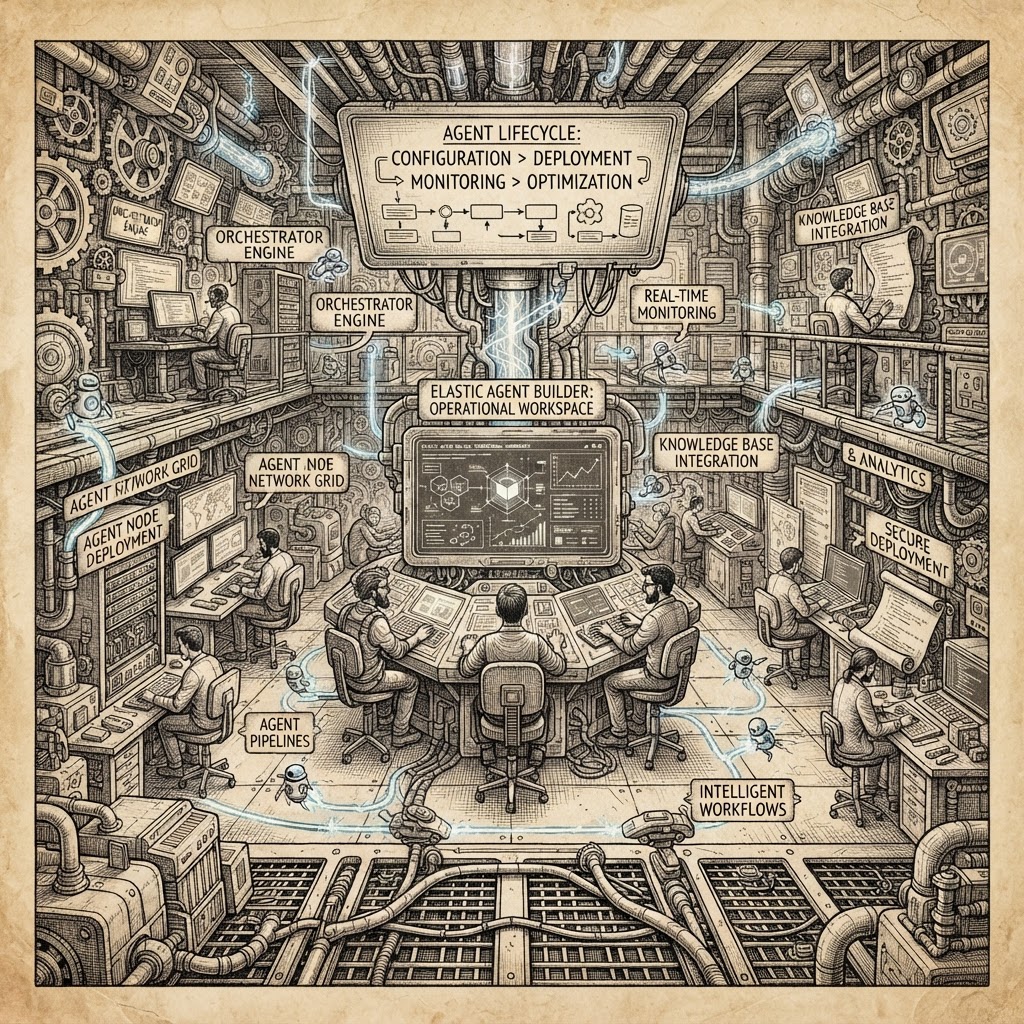
The most intriguing development in enterprise AI is not the pursuit of more accurate conversational responses. It is the disappearance of the boundary between asking an AI a question and executing the subsequent work. Elastic Agent Builder is leading this trend by moving away from being a mere interface over Elasticsearch data. It is maturing into a centralized workspace where users analyze information, build complex visualizations, trigger workflows, and connect external systems.
This evolution changes the role of the AI assistant significantly. Instead of sitting beside the operational platform, the conversational layer is becoming an intrinsic part of the platform itself. This shift marks a transition from transient text answers to persistent operational artifacts.
From Answers to Persistent Artifacts
Elastic's latest documentation indicates that Agent Builder agents can now create and manage dashboards and visualizations directly within a chat thread. A user can request a dashboard displaying CPU and memory usage, and the agent generates ES|QL powered visualizations. The user can then preview the dashboard, refine it through conversation, and save it into Kibana.
This is not just a convenient feature. It represents a deeper architectural change. Traditional AI assistants provide answers, which are transient. A dashboard is an artifact: it can be saved, shared, revisited, monitored, and governed. By embedding these artifacts into the conversation, the value of the AI interaction extends well beyond the initial query.
Natural Language as a Platform Interface
Historically, completing a complex operational task required jumping between multiple interfaces: investigating data, writing queries, building visualizations, assembling dashboards, and configuring automations. Agent Builder collapses these fragmented actions into a single conversation. The user describes the desired outcome, and the agent determines the necessary capabilities to create the corresponding operational artifacts.
This workflow follows a new model: Ask, Generate, Inspect, Refine, and Save. By reducing the translation effort between AI output and operational systems, Elastic is making the AI interface a primary driver of technical productivity.
Action and Interoperability
Dashboards provide the visibility, but connectors and tools enable the action. Elastic Agent Builder supports custom tools, workflow tools, and connectors to external services. By dynamically using configured connectors, agents can interact with third party systems without requiring every action to be mapped manually to a specific agent.
Furthermore, the adoption of the Model Context Protocol (MCP) expands this utility beyond Kibana. Elastic agents can act as MCP clients to consume tools from external servers or expose their own capabilities to other AI applications. This interoperability is vital because enterprises rarely operate with a single, universal agent. Instead, they manage specialized agents across security, development, and observability. Providing a standardized way for these systems to communicate prevents the formation of isolated AI silos.
Deterministic Automation and Governance
One of the fundamental challenges with LLMs is the gap between reasoning and deterministic execution. Elastic addresses this by integrating with Elastic Workflows. While the agent handles the reasoning, the workflow provides the deterministic control needed for production systems. This hybrid approach ensures that sensitive actions are executed according to strict, predefined processes rather than relying solely on the improvisational nature of a language model.
As agents gain the ability to modify systems, invoke APIs, and interact with external services, the importance of governance increases. Elastic's focus on human in the loop controls and audit trails is essential. An enterprise agent must not only be capable, but it must also be secure. Design principles should ensure that as capabilities grow, so do the checks and balances, such as defined user permissions and comprehensive logging.
The Future of Operational Context
We are moving toward a model where the conversation itself serves as a valuable record of operational context. A single thread can encompass intent, data, queries, tool calls, and final approvals. For incident response and security investigations, this drastically reduces the inefficiency of reconstructing context from disconnected sources. Ultimately, the industry is discovering that the real opportunity lies in how much of the actual workflow can safely move into the conversation. If this trend holds, conversation will become one of the primary ways professionals operate their existing systems.