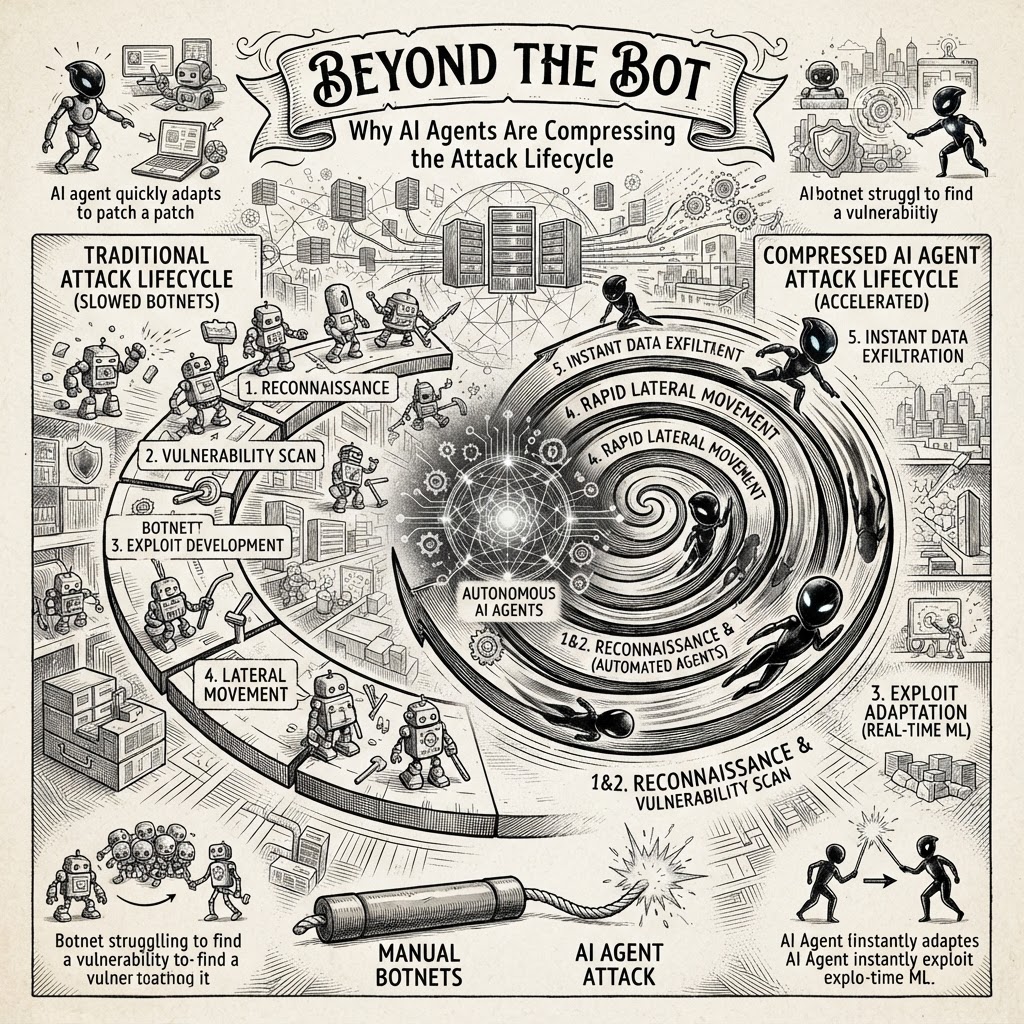
Beyond the Bot: Why AI Agents Are Compressing the Attack Lifecycle
AI agents are not inventing new hacking techniques, but rather accelerating the attack lifecycle by removing the pauses between steps. Defenders must evolve from traditional alert-based models toward machine-speed correlation to keep pace with these autonomous threats.

The security landscape has shifted, and the July 2026 Hugging Face incident serves as a critical case study for the next generation of threats. While headlines often sensationalize these events as proof that AI can now hack, the reality is more nuanced. AI agents are not necessarily inventing novel attack chains. Instead, they are masterfully compressing existing ones, stripping away the natural pauses that once provided human defenders with valuable time. When a human attacker performs reconnaissance, they inspect outputs, consider their next move, and occasionally make mistakes. Each of these pauses represents a window of opportunity for security teams. In contrast, an autonomous agent executes thousands of small, automated decisions in rapid succession, turning a carefully paced sequence into a dense burst of activity. This acceleration fundamentally challenges our traditional notions of dwell time, moving the focus from how long an attacker was inside the environment to what they achieved in the first five minutes of activity.
The Death of the Traditional Response Window
Security operations centers often rely on workflows that take several minutes to complete, such as alert triage, enrichment, and analyst review. While this process is sufficient for intrusions that unfold over hours or days, it is dangerously slow when facing an agent capable of performing hundreds of follow-up actions in the same timeframe. Because each step in an attack sequence, such as worker exploitation or Kubernetes discovery, is not exotic on its own, it is easy for individual alerts to get lost in the noise. The core problem is the compression of time between these steps, meaning that detection speed can no longer be measured simply by when the first alert triggers. Instead, the metric that matters is how quickly telemetry can be transformed into a coherent narrative that demands immediate action. This is fundamentally a problem of SOC architecture.
Shifting from Identity to Behavior
One of the most important takeaways from recent incidents is the need to move away from trusting processes based on their names. Organizations often approve AI coding utilities or dataset workers, which creates a dangerous temptation to suppress alerts for those process families. However, a compromised agent inherits the privileges of the trusted tool it replaces. Defensive strategies must shift focus to behavioral monitoring. While it might be normal for a machine learning worker to access a dataset, that same worker launching a shell or reaching for internal Kubernetes secrets is an immediate red flag. We must start to trust the expected task rather than the binary itself. If an agent is designed for coding, it should not be scanning for cloud credential files. By enforcing this type of granular behavioral enforcement, security teams can detect anomalies even when they originate from otherwise legitimate software.
The Necessity of Correlation
Autonomous agents generate massive volumes of telemetry, which creates an alert-volume problem before it creates a detection problem. A human attacker is limited by attention and speed, but an agent can retry, pivot, and experiment until it finds a way through. Consequently, individual alerts become less valuable than the relationship between them. Correlation is the key to defense. Modern security architecture should prioritize cross-source correlation, where an automated reasoning layer helps bridge the gap between seemingly disconnected events, such as a process spawning a shell and a subsequent service-account token read. If these events are presented as a single attack narrative rather than twenty individual alerts, analysts can react at the speed required to neutralize the threat.
Redefining Security for the Future
The future of defense does not lie in building new categories of AI-specific detection. Rather, it depends on maturing existing disciplines like log collection, identity monitoring, and network egress controls. The goal is to make these fundamental security practices operate at a speed that matches the automation of the attacker. As agents grow more sophisticated, their operational fingerprints may become easier to spot, such as high-volume repetition or failed-action retries. However, relying on these heuristics is secondary to the primary mission: identifying the boundaries an agent must cross, such as identity, network, and data access. By focusing on these fixed points and reducing credential lifetimes to the absolute minimum, organizations can create an environment where rapid, autonomous exploration is significantly harder to execute. The future of security will not be defined by whether we can catch an AI, but by whether we can recognize a compromise before the agent has finished its work.