Beyond Data Gravity: How Cross-Project Search Redefines Architectural Sovereignty
Elastic's new Cross-Project Search marks a shift toward federated data access, enabling organizations to maintain strict isolation boundaries without sacrificing global visibility. By decoupling physical data location from analytical scope, this feature transforms how enterprises approach observability, security, and AI context management.
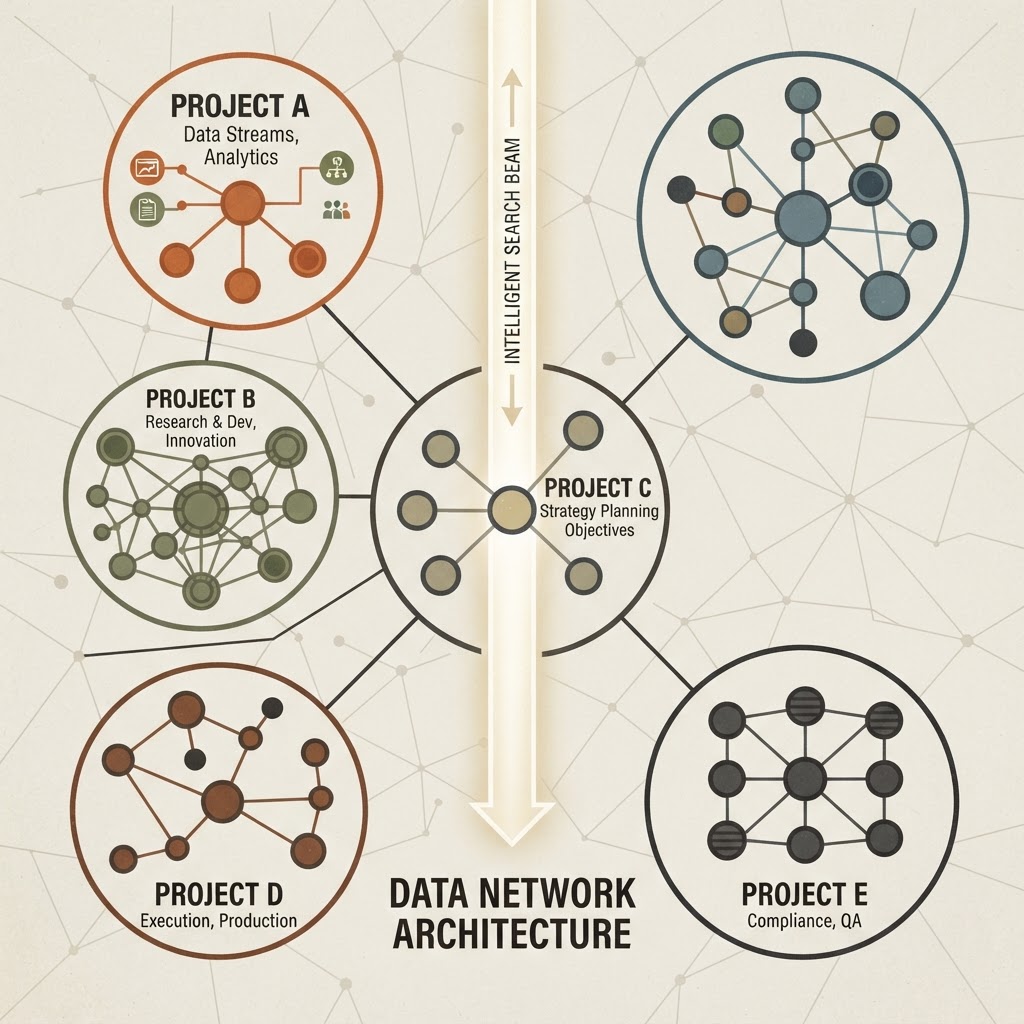
The False Dichotomy of Data Strategy
For decades, enterprise architects have operated under the assumption that visibility requires centralization. The prevailing logic was simple: if you want to query data together, you must store it together. This led to the rise of massive data lakes, complex ETL pipelines, and the constant, expensive movement of information across networks. We built these pipelines because the cost of data movement seemed lower than the cost of operational blindness. Yet, this approach created a false dichotomy. Organizations felt they had to choose between the safety of isolation, which offers security and regulatory compliance, and the utility of a shared view, which offers operational insights.
Elastic's move to make Cross-Project Search (CPS) generally available for Elastic Cloud Serverless challenges this outdated mandate. By allowing queries to traverse project boundaries without forcing data consolidation, Elastic is not merely offering a search feature; it is proposing a new architectural paradigm where the location of data is no longer a barrier to the truth. The thesis here is clear: sovereignty and transparency are no longer mutually exclusive. Organizations can now design their data architecture around governance requirements rather than the limitations of their query engines.
The Architectural Cost of Centralization
Traditional data centralization is an expensive, brittle, and risky endeavor. When an organization decides to pipe data from regional or tenant-specific clusters into a single global instance, they incur several hidden taxes. First, there is the engineering tax of building and maintaining robust ingestion pipelines that must handle massive scale while ensuring data integrity. Second, there is the latency tax, as data becomes stale the moment it moves. Finally, there is the compliance tax, as centralizing sensitive data often forces organizations to adhere to the strictest regulatory standards across the entire pool, rather than applying them locally.
CPS flips this model. By allowing the search engine to act as a federated layer, the data stays exactly where it was created. If a European team generates logs that must remain in Frankfurt for GDPR purposes, those logs remain in the European project. A security analyst in North America can still include that project in a global threat hunt without the data ever leaving its sovereign boundary. This preserves the benefits of local data residency while providing the benefits of global context.
Decoupling Privilege from Visibility
One of the most common criticisms of federated search is the fear that it weakens security postures. Skeptics often argue that connecting multiple data silos creates a sprawling attack surface or invites accidental data leakage. However, Elastic's implementation of CPS proves the opposite. By keeping authorization bound to the individual projects, Elastic enforces the principle of least privilege at the granular level.
When a user initiates a cross-project search, the query engine respects the access control lists (ACLs) of every participant. If the analyst performing the search lacks permission to view data in a specific project, the engine simply ignores that project for that user. This creates a critical architectural distinction: federated visibility does not imply federated privilege. Security teams can grant access to global search tools without granting blanket access to the underlying sensitive telemetry. The query acts as an authenticated bridge, not a leaky pipe.

The Evolution of Contextual Intelligence
In the era of AI and Large Language Models, the value of data is defined by its context. An AI agent is essentially a reasoning engine, but its output is only as accurate as the data it can access. If an agent is limited to a single silo, it suffers from context starvation. It cannot link a latency spike in a web tier to an authentication error in a database tier if those systems belong to different projects.
CPS provides the infrastructure for AI-driven observability. By allowing agents to query across multiple projects via the Elastic Agent Builder, organizations can provide their AI tools with a holistic view of the ecosystem. The agent does not need to have all the data moved to its own environment; it just needs the ability to perform a discovery operation across the relevant telemetry. This transforms CPS into a fundamental piece of context infrastructure, enabling agents to correlate signals across geographically and organizationally disparate systems in real time.
Managing Complexity at Scale
Operating a distributed system is historically difficult, particularly when it involves manual wiring of clusters, certificate management, and version synchronization. Elastic's serverless approach removes this friction. By moving the complexity to the control plane, Elastic Cloud allows users to focus on logical namespaces. Whether you are managing five projects or one hundred, the interface remains consistent.
However, this ease of use introduces a new responsibility: query hygiene. Because federated search adds a performance cost for each participating project, developers and admins must become smarter about scope. Using ES|QL to route queries only to the relevant projects, rather than broadcasting a request to every project in the organization, is an essential optimization. As we move away from data silos, we must embrace the discipline of intelligent routing, ensuring that our search tools remain responsive even as the amount of connected data grows.
Conclusion: The End of the Silo Era
The true innovation of Cross-Project Search lies in how it changes the psychological relationship between the developer and the infrastructure. For too long, the physical location of data has been an inescapable constraint on our ability to solve problems. We have spent years forcing data into central containers because we lacked the tools to do anything else.
Elastic has provided a way to bypass this bottleneck. By treating projects as logical namespaces rather than impenetrable vaults, they have enabled a future where data can live where it is most efficient and compliant, while remaining fully accessible to those who need it. This shift toward federated data access is not just a trend; it is the natural maturation of cloud architecture. As organizations connect more services, more regions, and more autonomous AI agents, the ability to search broadly while maintaining local control will become the hallmark of a resilient enterprise.