Benchmarks Fail Without Adversarial Testing
Engineering benchmarks are frequently misused as static proof of superiority rather than dynamic tools for system exploration. This article examines the launch of the Luxir search engine to argue that true performance understanding only emerges when engineers aggressively attempt to break existing test harnesses.

Engineering Performance Through Adversarial Inquiry
When a new technology like the Luxir search engine appears with bold claims of 1.6x throughput over industry standards like Elasticsearch, the community typically responds with predictable skepticism or blind adoption. However, both reactions miss the deeper utility of such announcements. Benchmarks are rarely definitive answers, but they are incredibly potent questions when treated as a baseline for adversarial engineering. The value of a benchmark is not found in the final throughput figure, but in the structural transparency that allows other engineers to stress, manipulate, and ultimately break the test configuration.
The Architecture of Misconception
Search performance is not a singular metric. It is a multidimensional consequence of index size, hardware utilization, concurrency, and query complexity. When an engine is labeled faster, we must immediately ask which variables were fixed to achieve that result. Is it a CPU bound task or an I/O bottleneck? Does the engine rely on heavy indexing caches or high cardinality filtering?
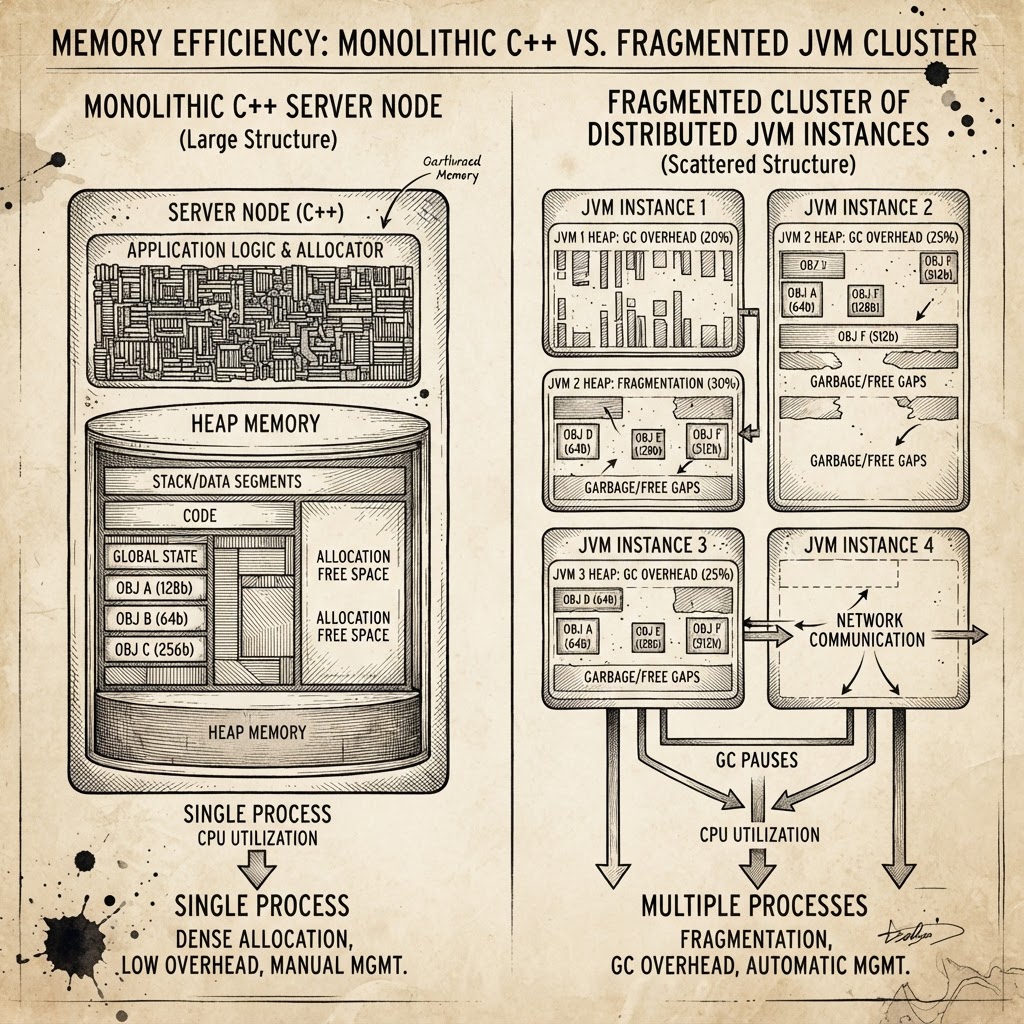
Luxir represents an interesting architectural departure because it leverages modern C++ to bypass garbage collection constraints and memory management overhead common in Java based systems. By favoring large, monolithic nodes, it challenges the industry standard of distributed horizontal scaling. This decision is significant in the current cloud economic landscape, where memory and CPU on single large instances can sometimes offer better price performance ratios than a complex, network intensive cluster of smaller nodes.
Testing the Boundaries of Systems
Because Luxir is currently a single node, pre-release engine, it lacks many production grade features like authentication, TLS, and replication. Some critics might argue this invalidates the performance comparison, but that is a shortsighted view. A performance benchmark is simply an experiment. The challenge for the engineering community is not to ignore these early figures, but to build upon them. If we want to understand if native C++ performance holds up against established JVM systems, we must gradually add these missing production requirements to the benchmark harness to see where the performance gains evaporate.
Adding real world variables is the only way to validate an architectural bet. We must test against high concurrency scenarios, simulate node failure recovery, and measure performance under memory pressure. If an engine remains performant while handling role based access control and hybrid vector retrieval, then the architectural claims become robust. If not, we have discovered the specific ceiling of that design philosophy.
Shifting Metrics Toward Economics
Raw throughput is becoming a secondary metric to total cost of ownership. In the modern cloud era, a system that is 20 percent faster but requires triple the operational labor or specialized hardware is ultimately slower in economic terms. We must begin to frame our benchmarks around successful production queries per dollar. This includes the cost of compute, RAM, storage, and the hidden overhead of maintaining replicas and coordinating distributed states.
The Responsibility of Public Benchmarking
The most commendable aspect of the Luxir release is the public availability of its benchmark harness. Open source software should be judged by its ability to be scrutinized. When engineers can reproduce, modify, and break these tests, they are engaging in a higher form of technical discourse. The objective of a benchmark should be to force it to fail, because only by observing the point of failure can we understand the limitations of the underlying design.
Future technical assessments must reject the idea that a benchmark ends a debate. A chart is the start of an engineering investigation, not the conclusion. By prioritizing transparency and inviting adversarial scrutiny, the community can move past marketing hype and into a deeper understanding of how modern software architectures handle the evolving demands of data intensive applications.